
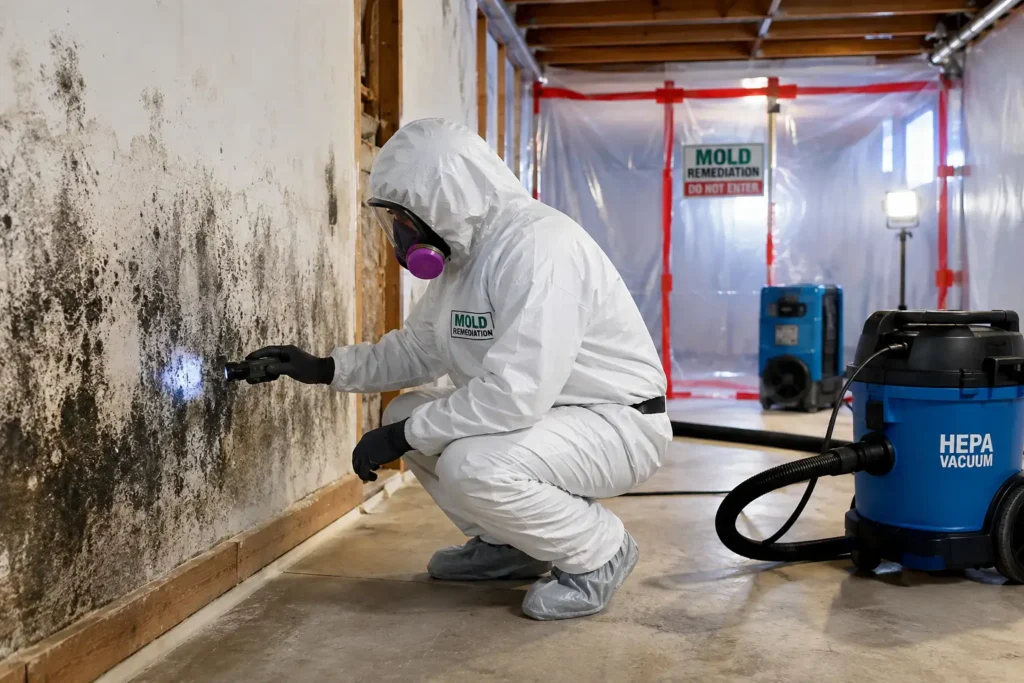
Mold remediation Peoria IL homeowners need after water damage is one of the most misunderstood restoration services – not because the process is complicated, but because so much of what drives the cost and timeline happens inside walls, above ceilings, and in crawlspaces where homeowners can’t see it. By the time mold becomes visible on a surface, it has usually been growing inside structural materials for days or weeks.
This guide covers what mold remediation actually involves from start to finish, what affects the timeline, and how Peoria’s specific climate and housing conditions make mold a more persistent problem than in drier regions.
Why Mold Grows Faster in Peoria IL Than Most Homeowners Expect
Peoria’s humidity profile creates near-ideal mold growth conditions for a significant portion of the year. From May through September, outdoor relative humidity regularly exceeds 70 percent across central Illinois. That ambient moisture, combined with the Illinois River’s influence on local groundwater and the prevalence of block-foundation homes in older Peoria neighborhoods, means wet materials stay wet longer than they would in a drier climate.
Mold remediation Peoria IL jobs that follow water damage events tend to involve larger affected areas than comparable jobs in dry climates for one simple reason – the time between a water event and professional drying in humid conditions gives mold more opportunity to establish itself in materials that should have dried faster.
The 24 to 48 hour window that mold guidelines reference assumes average indoor conditions. In a Peoria basement during July, with outdoor humidity at 80 percent and limited air circulation, that window can be shorter. Understanding this is what makes the case for professional response speed, not just professional remediation quality.
What Mold Remediation Peoria IL Actually Involves – Step by Step
Mold remediation is not cleaning visible mold off a surface. That’s a common misconception that leads to recurring mold problems – surface cleaning removes what you can see while leaving the root structure (mycelium) intact inside porous materials. Professional remediation addresses the full contamination, not just the surface presentation.
Here’s what our mold remediation services process covers on every job:
Step 1 — Mold inspection and air sampling
Before any work begins, a full inspection maps every area of mold growth – visible and hidden. Air quality sampling establishes pre-remediation spore counts, which become the baseline for post-remediation clearance testing. Our mold inspection and testing service uses surface swabs and air cassette sampling to identify the mold species present and the full extent of contamination before a remediation plan is developed.
Step 2 — Containment setup
Affected areas get sealed with plastic sheeting to prevent spore spread during removal. Negative air pressure machines create airflow from clean areas toward the containment, so disturbed spores move toward HEPA filtration rather than into the rest of the home. This is not optional – remediation without containment routinely spreads mold to previously unaffected rooms.
Step 3 — Material removal
Any porous material with active mold growth – drywall, insulation, carpet, subfloor – gets removed and disposed of in sealed bags. The IICRC standard for porous materials with mold is removal, not cleaning. Surface cleaning of drywall with bleach or antimicrobial agents does not eliminate mold inside the paper backing or the gypsum core. It removes surface color while leaving viable spores that re-establish within weeks.
Step 4 — HEPA vacuuming and antimicrobial treatment
All remaining structural surfaces – framing, concrete, block walls – get HEPA vacuumed to remove loose spores, then treated with EPA-registered antimicrobial agents. In Peoria basement jobs specifically, block foundation walls require multiple treatment applications because the porous surface holds spores in the block cavities.
Step 5 — Air scrubbing
HEPA air scrubbers run continuously throughout the remediation process and for a defined period after material removal is complete. These units filter air through HEPA media that captures particles down to 0.3 microns, well below the size of mold spores.
Step 6 — Post-remediation clearance testing
After all work is complete and the space has been cleaned, independent air sampling confirms spore counts have returned to normal levels. Clearance testing by a third party is the professional standard – a remediation company testing its own work is not an adequate verification.
How Long Does Mold Remediation Take in Peoria IL?
The timeline depends on the scope of contamination, the materials involved, and whether the source of moisture has been fully addressed before remediation begins.
Small contained mold event — single wall section, caught early, less than 10 square feet:
- Inspection and containment: Day 1
- Material removal and treatment: Days 1 to 2
- Air scrubbing: Days 2 to 3
- Clearance testing and results: Day 4 to 5
- Total: 4 to 5 days
Moderate mold contamination — basement wall sections, multiple rooms, 10 to 100 square feet:
- Inspection, containment, and removal: Days 1 to 3
- Treatment and air scrubbing: Days 3 to 5
- Clearance testing: Day 6
- Reconstruction planning: Week 2
- Total: 1 to 2 weeks for remediation, plus reconstruction
Extensive contamination — whole basement, attic, or multiple rooms, over 100 square feet:
- Full inspection and containment setup: Day 1 to 2
- Material removal – multiple phases: Days 2 to 7
- Treatment and extended air scrubbing: Days 7 to 10
- Clearance testing: Day 11 to 12
- Reconstruction: Weeks 2 to 4 depending on scope
- Total: 3 to 6 weeks from start to completed reconstruction
For mold remediation Peoria IL jobs in older homes with block foundations and limited ventilation, jobs consistently run toward the longer end of each range because block walls require more treatment time and attic mold in older construction involves more structural complexity than modern framing.
Black Mold – What It Is and When It Requires Specialized Treatment
Black mold is one of the most searched terms in mold remediation, and also one of the most misunderstood. The term “black mold” colloquially refers to Stachybotrys chartarum – a specific mold species that produces mycotoxins and requires careful handling. In practice, not every dark-colored mold is Stachybotrys, and identifying the species requires laboratory analysis of samples taken during inspection.
Our black mold remediation and removal service uses species identification before developing the remediation protocol, because Stachybotrys requires stricter containment, more complete PPE for technicians, and more thorough post-remediation clearance than many other common mold species.
In Peoria homes, Stachybotrys is most commonly found in situations involving prolonged moisture exposure – basements that took on water and weren’t professionally dried, roof leaks that went undetected for multiple seasons, or HVAC systems that developed moisture problems. It grows more slowly than many other mold species, which means its presence usually indicates a moisture problem that has been active for weeks or months, not days.
Basement Mold in Peoria IL – The Most Common Scenario
Basement mold accounts for the majority of mold remediation Peoria IL calls, and the pattern is almost always the same – water entered the basement at some point, was either not addressed or incompletely addressed, and mold established itself on the drywall, framing, and insulation before anyone noticed visible growth.
In West Central, East Bluff, and other established Peoria neighborhoods where block foundations are standard, the sequence often starts with groundwater intrusion during Illinois River flooding season. Block absorbs water readily, stays wet for extended periods, and provides the moisture that drives mold growth on adjacent drywall and insulation bats.
Our basement mold cleanup process for Peoria homes starts with moisture readings on every affected surface, because the remediation scope needs to account for what’s happening inside the wall cavity, not just what’s visible on the surface. Active moisture behind drywall means the moisture source needs to be addressed – drainage improvements, sump pump repair, or foundation waterproofing – before remediation begins. Cleaning mold from a surface that’s still actively receiving moisture is a temporary fix that repeats itself in 30 to 60 days.
What Happens After Mold Remediation – Reconstruction
Mold remediation removes the contamination. Reconstruction restores the space. These are two separate phases, and understanding the difference helps homeowners plan the total timeline and total cost.
After clearance testing confirms the remediated space meets safe spore levels, reconstruction begins – replacing removed drywall, reinstalling insulation, repainting, and restoring flooring. In most basement mold jobs, reconstruction follows within one to two weeks of clearance testing.
The reconstruction phase is also when any root cause fixes – improved drainage, vapor barrier installation, ventilation improvements – get implemented before new materials go in. Installing new drywall over a wall cavity that hasn’t had its moisture source addressed is the most reliable way to repeat the mold problem within a season.
Mold and Insurance – What Peoria Homeowners Should Know
Mold remediation coverage under standard Illinois homeowner’s insurance policies depends entirely on the cause of the mold. If the mold resulted from a sudden and accidental water event – a burst pipe, storm intrusion through a roof – the resulting mold remediation is typically covered as part of the water damage claim.
If mold resulted from gradual moisture intrusion, deferred maintenance, or flooding from external sources like groundwater or Illinois River overflow, standard policies typically exclude it. Separate flood insurance through FEMA’s National Flood Insurance Program may cover mold remediation that traces back to a covered flood event.
According to the EPA’s guidelines on mold and moisture control, the best way to prevent costly remediation is addressing any moisture source within 24 to 48 hours of discovery – which is exactly why the connection between water damage response speed and mold prevention is so direct. Our sewage backup cleanup guide also covers how category 3 water events create accelerated mold risk that requires a different response timeline than clean water events.
Mold Remediation Peoria IL – Areas We Serve
Our mold remediation team serves Peoria and surrounding Peoria County communities including West Central, East Bluff, Bartonville, Dunlap, North Florence, Edwards, Hanna City, Peoria Heights, and Downtown Peoria. For older neighborhoods with pre-1970s construction and block foundations, our assessment process accounts for the specific materials and moisture patterns common to that era of building.
Final Thought – Mold Remediation Peoria IL Starts With Finding the Source
Mold remediation Peoria IL done right starts before any material is removed – it starts with identifying and addressing whatever moisture source allowed mold to establish in the first place. Skip that step, and the same mold returns in the same location within weeks of completing the remediation.
For mold remediation Peoria IL response right now, call (309) 549-1827) – available 24 hours a day, seven days a week, with same-day inspection and assessment across Peoria and surrounding Peoria County communities.
Leave a Reply