
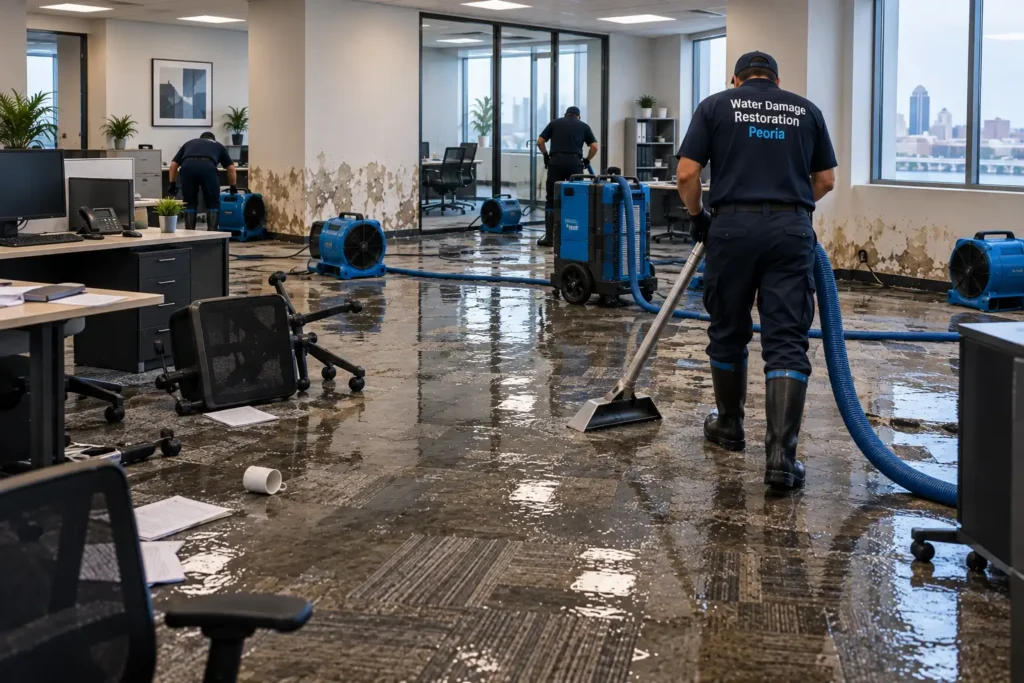
Commercial water damage restoration Peoria IL businesses face is a categorically different challenge from residential water damage – not just in scale, but in the stakes involved. When a home floods, a family is displaced and stressed. When a business floods, there’s the same stress plus employees who can’t work, customers who can’t be served, revenue that stops the moment the water enters, and regulatory obligations that determine whether you can legally reopen.
This guide is written specifically for Peoria business owners and commercial property managers who want to understand what makes commercial water damage different, what the restoration process actually involves for a commercial property, and what decisions made in the first few hours after a water event have the biggest impact on total outcome.
How Commercial Water Damage Differs From Residential – What Business Owners Need to Understand
The mechanics of water damage are identical whether it’s a home or a business – water enters, materials absorb it, mold begins within 24 to 48 hours if moisture isn’t extracted. But everything around those mechanics changes when the property is commercial.
Business continuity pressure – every hour a commercial space is out of operation has a direct, measurable cost. A retail space that can’t open loses revenue. A restaurant with a flooded kitchen loses the day’s service. An office building with a compromised floor displaces teams. This pressure to reopen quickly is real and legitimate – but it’s also the pressure that leads to the most common and most expensive mistake in commercial restoration: starting reconstruction before the space is genuinely ready.
Regulatory requirements – commercial properties in Peoria and Peoria County must meet Illinois building codes and health department standards before they can legally reopen employees and customers. A business that attempts to operate in a space with active water damage or elevated moisture levels risks code violations, liability exposure, and potential forced closure on top of the original damage.
Multi-tenant complexity – in multi-story or multi-tenant commercial buildings, a water event on one floor becomes a water intrusion event for every tenant below it. Coordinating restoration across multiple tenant spaces, each with different lease terms and different insurance policies, adds a layer of complexity that residential jobs don’t involve.
Higher equipment requirements – commercial spaces have higher ceiling heights, open floor plans, and larger square footage than residential properties. Structural drying in a commercial building requires more equipment per square foot and longer equipment run times than equivalent residential work.
This is what makes commercial water damage restoration Peoria IL a fundamentally different engagement than residential work – the technical process is similar, but everything around it operates under different pressure and different stakes
Most Common Sources of Commercial Water Damage in Peoria IL
Understanding the source is the first step in any commercial water damage restoration Peoria IL job – it determines the cleanup category, the contamination level, and what your insurance will actually cover.
Sprinkler system activation – commercial buildings in Peoria are required by Illinois fire code to have sprinkler systems, and those systems discharge when triggered by heat or smoke – including false activations. A multi-head discharge in a retail or office space can flood an entire floor in minutes, depositing water contaminated with system chemicals and accumulated pipe sediment across every surface.
Roof leaks during storm events – flat commercial roofs, standard on most Peoria commercial construction, are significantly more vulnerable to ponding water than residential pitched roofs. A single blocked drain during an Illinois storm event can allow thousands of gallons to accumulate before water finds its way inside through ceiling assemblies and HVAC penetrations.
Plumbing failures – burst pipes from Peoria’s winter freeze cycles, failed water heater connections, and supply line failures in restrooms and break rooms are among the most common commercial water damage sources. A pipe failure in an upper floor utility room becomes a ceiling intrusion event for every space below it.
Groundwater intrusion during Illinois River flooding – commercial basement spaces and ground-floor businesses in Peoria’s downtown corridor and riverfront areas face direct groundwater risk during Illinois River flooding season, March through June. Groundwater that enters commercial spaces carries agricultural runoff, sewer overflow, and bacterial contamination that classify it as category 3 water.
HVAC condensate failures – commercial HVAC systems produce significant condensate that’s normally channeled away through drain lines. When those lines clog or fail, condensate water intrudes into ceiling tiles, wall cavities, and flooring over days or weeks before anyone notices – by which point mold is often already establishing in the wet materials.
The Commercial Water Damage Timeline – Why Every Hour Matters More in a Business Setting
Commercial water damage restoration Peoria IL response needs to move faster than residential response for two reasons that directly relate to business outcomes.
First, the mold clock. Mold spore germination on wet organic materials begins within 24 to 48 hours regardless of whether the affected space is a home or a business. In Peoria’s humid summer months, that window can be shorter. A commercial space with active mold growth cannot legally reopen until remediation is complete and clearance testing confirms safe air quality levels – which adds weeks to an already disrupted timeline. Every commercial water damage restoration Peoria IL job that starts documentation and extraction within the first hour consistently results in shorter total downtime than one that waits for morning.
Second, the documentation clock. Insurance adjusters processing commercial claims need pre-cleanup documentation – photographs, moisture readings, and damage inventory – taken before any restoration work begins. The longer cleanup waits, the more secondary damage accumulates. But the documentation has to happen before cleanup starts. These two facts require restoration to begin immediately, documented correctly, from the first hour.
Our water mitigation process covers the mitigation phase in detail – the same principles that apply to residential mitigation apply to commercial work, with the added urgency of business continuity requirements.
What Commercial Water Damage Restoration Actually Involves
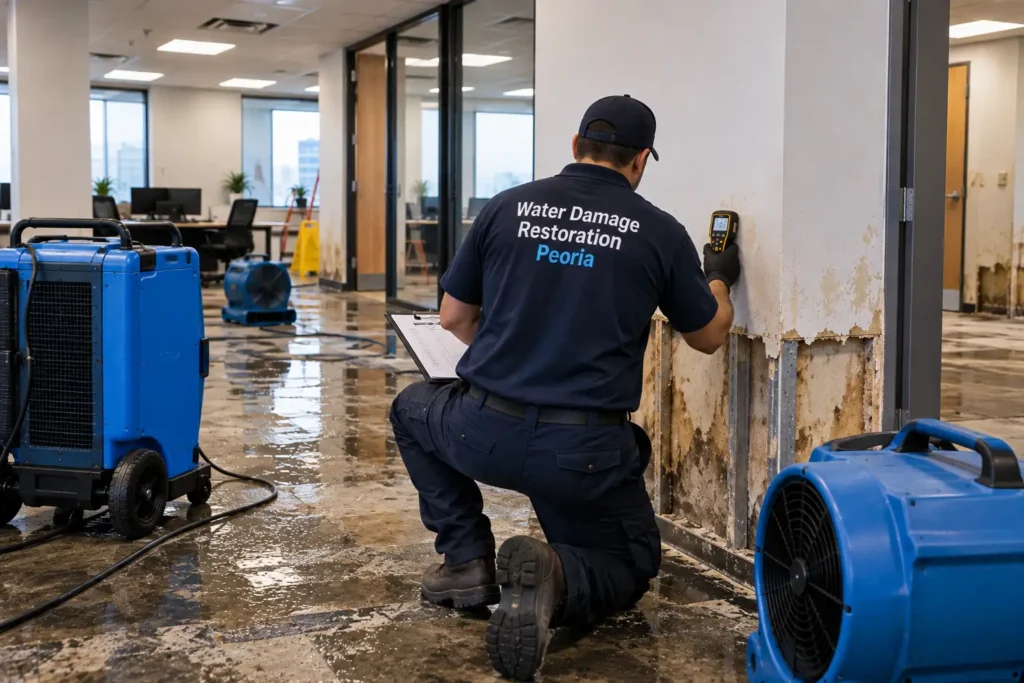
Commercial water damage restoration Peoria IL professional process follows the same core phases as residential work – but each phase is larger, more complex, and involves more coordination between trades.
Phase 1 – Emergency Extraction and Commercial Moisture Mapping
Commercial extraction starts with higher-capacity equipment than residential jobs – truck-mounted systems that move significantly more water per hour, combined with portable units for areas that truck access can’t reach directly. Before extraction begins, a full moisture assessment maps every wet zone across the commercial footprint using thermal imaging and calibrated moisture meters, identifying water that has traveled into wall cavities, ceiling assemblies, and subfloor material beyond the visible damage area. This moisture map is the foundation of every commercial water damage restoration Peoria IL drying plan – equipment placement decisions are only as good as the assessment behind them.
Phase 2 – Structural Drying at Commercial Scale
Our structural drying process for commercial properties uses industrial-scale dehumidifiers and air movers placed according to the moisture map, with daily readings tracked and documented until all structural materials reach acceptable moisture levels. Commercial spaces require more equipment per square foot than residential jobs because of higher ceiling heights and open floor plans that change how air circulation works during drying.
Phase 3 – Content and Equipment Handling
Commercial water damage almost always involves business equipment, inventory, electronics, and in some cases sensitive documents that need to be assessed, inventoried, and moved or dried separately from the structural work. Wet business equipment and water-damaged inventory all require handling protocols that differ from standard residential content work.
Phase 4 – Disinfection and Decontamination
For commercial water damage involving external water sources, groundwater, or sprinkler system water, disinfection of all remaining structural surfaces is a required step before reconstruction begins. Our disinfection services for commercial properties use EPA-registered products applied at concentrations appropriate for the contamination level – with documentation that health department inspectors and building officials may require before the space can reopen.
Phase 5 – Reconstruction and Reopening
Commercial reconstruction involves coordination between multiple licensed trade contractors – electricians for affected panels and wiring, HVAC technicians for compromised ductwork and equipment, and general contractors for structural repairs. City of Peoria building permits are required for most structural repair work, and inspections must pass before the space can legally reopen.
Large Loss Commercial Events – When the Scale Changes Everything
Some commercial water damage restoration Peoria IL events exceed what standard restoration crews handle – multi-floor flooding, whole-facility events, or simultaneous damage across multiple tenant spaces all require a large loss approach.
These large loss situations require a different deployment approach. Our large loss restoration services scale equipment and personnel to the event rather than applying a standard residential-sized crew to a commercial-scale problem. Large loss commercial jobs also require more intensive project management – coordinating multiple trade contractors, managing phased reopening of unaffected sections while affected areas are restored, and maintaining continuous communication with property management and tenants throughout the process.
Commercial Water Damage Insurance – What Peoria Business Owners Should Know
Commercial property insurance handles water damage claims differently from residential homeowner policies, and the differences matter significantly when you’re trying to get a business back open.
Most commercial property policies cover sudden and accidental water damage from internal sources – plumbing failures, sprinkler activations, and appliance failures. What they typically exclude, similar to residential policies, is flooding from external sources. Groundwater intrusion from Illinois River flooding and storm surge events require separate commercial flood insurance through FEMA’s National Flood Insurance Program – and many Peoria commercial properties in flood zone areas don’t have this coverage until after their first significant flooding event.
According to FEMA’s commercial flood preparedness resources, businesses in designated flood zones should evaluate their NFIP coverage annually, particularly before Illinois River flooding season each spring.
Business interruption coverage is the other policy component worth reviewing. If your commercial policy includes business interruption coverage, it may compensate for lost revenue during the restoration period – but only if the claim is filed correctly and the restoration documentation meets the policy’s specific requirements. Working with a restoration company that provides thorough daily documentation and moisture logging directly supports business interruption claims. Documentation quality is what separates a smooth commercial water damage restoration Peoria IL insurance claim from a disputed one and it starts on day one, not after the job is done.
Downtown Peoria and East Peoria Commercial Properties – Local Risk Factors
Commercial properties along the Peoria riverfront and in East Peoria face water damage risk factors that inland commercial properties don’t. The Illinois River’s seasonal flooding pattern, combined with the combined sewer system that serves much of downtown Peoria, creates a specific risk profile during heavy rain events.
When the combined sewer system reaches capacity during a major storm – which happens during significant rain events in Peoria – sewage can back up into commercial floor drains and basement mechanical rooms. For restaurants, food service businesses, and any commercial space with below-grade plumbing, this creates a category 3 contamination situation that requires full decontamination before any reopening is legally permissible.
For East Peoria commercial properties specifically, where the Illinois River’s influence extends across Tazewell County during major flooding events, our East Peoria service area includes commercial properties across the Route 8 and Washington Street corridors where riverine flooding has historically affected ground-floor commercial spaces.
What to Do in the First Hour After Commercial Water Damage
The first hour after discovering water damage in a commercial property determines more about the total outcome than any other period in the restoration process.
- Ensure electrical safety – if water has reached electrical panels, outlets, or mechanical equipment, do not enter the affected area until the utility company or a licensed electrician confirms power is off to those circuits
- Do not run HVAC – running forced air through a water-damaged space spreads moisture to unaffected areas and introduces contamination through ductwork
- Document before touching anything – photographs and video of every affected area before any furniture is moved or water is touched
- Contact your insurer – commercial policies typically have notification requirements; missing them can complicate claims even when damage is clearly covered
- Call for professional extraction immediately – the single most impactful decision in commercial water damage is how fast professional extraction equipment arrives on site
Commercial water damage restoration Peoria IL response that starts within the first few hours of a water event consistently results in shorter total downtime, lower total cost, and a cleaner path to reopening than response that begins the following day.
Final Thought – Commercial Water Damage Restoration Peoria IL Is a Business Decision, Not Just a Restoration Job
Every commercial water damage restoration Peoria IL job involves two parallel tracks: the restoration track, which follows the technical process of extraction, drying, disinfection, and reconstruction; and the business track, which involves insurance documentation, regulatory compliance, and managing the impact on operations and revenue.
Getting both tracks right requires a restoration partner who understands that the goal isn’t just a dry building – it’s a building you can legally, safely, and confidently reopen to your employees and customers.
For commercial water damage restoration Peoria IL response right now, call (309) 549-1827 – available 24 hours a day, seven days a week, with commercial-scale equipment and the documentation protocols that support both your restoration and your insurance claim.
FAQ Section
Q1: How is commercial water damage restoration different from residential?
The core process – extraction, drying, disinfection, reconstruction – is the same. What’s different is scale, regulatory requirements, documentation standards, and the business continuity pressure that makes timeline management critical. Commercial properties must meet building code and health department standards before legally reopening, which adds a compliance dimension that residential jobs don’t involve.
Q2: How long does commercial water damage restoration take in Peoria IL?
Timeline depends on the scale of the event, the materials affected, and how quickly extraction began. Small contained commercial events can complete in one to two weeks. Major flooding events affecting multiple floors or large square footage can run four to eight weeks or longer, particularly when structural repairs require City of Peoria building permits and inspections.
Q3: Does commercial property insurance cover water damage from Illinois River flooding?
Standard commercial property insurance covers sudden and accidental water damage from internal sources. Flooding from external sources – including Illinois River groundwater intrusion and overland flooding – requires separate commercial flood insurance through FEMA’s National Flood Insurance Program. Many Peoria commercial property owners don’t carry this coverage until after their first significant flood event.
Q4: Can employees work in the building during commercial water damage restoration?
In most cases, no – not in the affected areas. Air quality from elevated moisture, mold risk, and the presence of industrial drying equipment make occupancy of active drying areas inadvisable and potentially subject to OSHA workplace safety requirements. Unaffected sections of a building may remain operable if they can be properly isolated from the restoration work.
Q5: What documentation does a commercial water damage restoration company provide?
A professional commercial restoration company provides daily moisture logs showing readings at all monitored points, pre and post-extraction photographs, a complete scope of work document, and in contamination events, disinfection treatment records with EPA product registration documentation. This documentation package supports both the property damage claim and any business interruption claim.
Q6: Is mold remediation always required after commercial water damage?
Not always – but any commercial water damage event where extraction didn’t begin within 24 to 48 hours of the water event, or where external water sources were involved, requires a post-drying mold assessment before reconstruction begins. The mold risk is always present in commercial water damage situations and needs to be confirmed clear before new materials are installed.
Leave a Reply