
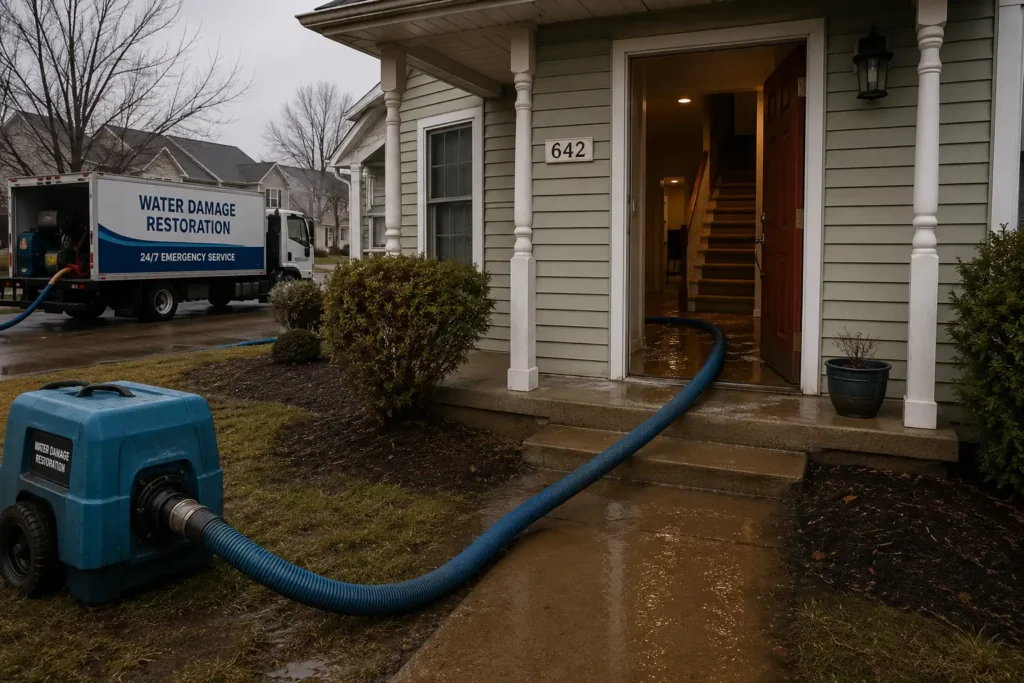
Water mitigation Peoria IL homeowners need immediately after any water event is the phase of the process that most people don’t have a name for — they just know they need someone to come deal with the water. Mitigation is that first phase. It’s what happens before restoration, before reconstruction, and before any decisions about what gets repaired or replaced.
Understanding what mitigation actually covers and why it’s distinct from restoration – helps Peoria homeowners make faster, smarter decisions in the hours after a flooding event, which is exactly when those decisions matter most.What Water Mitigation Actually Means
Mitigation means limiting damage. In the context of water damage, water mitigation Peoria IL refers to every action taken to stop water from spreading further and prevent secondary damage from developing after the initial water event.
It is not cleaning up. It is not repairing. It is not restoring the space to its original condition. Those are restoration activities that happen after mitigation is complete. Mitigation is the emergency intervention phase the actions that determine how much of the home is affected and how serious the damage becomes.
In practical terms, water mitigation for a Peoria home includes:
- Extracting standing water using commercial-grade equipment
- Removing saturated materials that will continue spreading moisture if left in place – carpet, padding, saturated drywall sections
- Setting up commercial drying equipment – dehumidifiers and air movers – to begin structural drying
- Applying antimicrobial treatment to affected surfaces to prevent mold establishment during the drying phase
- Documenting moisture levels and affected areas for insurance purposes
Everything after this – replacing drywall, refinishing floors, repainting – is restoration. Mitigation is what makes restoration possible.
Why Water Mitigation Peoria IL Has to Start Within Hours
The urgency of water mitigation is not a sales tactic. It’s driven by the physical behavior of water and the biology of mold.
Water migrates. From the moment it enters a home, it moves through capillary action into every porous material it can reach – drywall absorbs it vertically, subfloor material absorbs it horizontally, insulation holds it against framing members. A water event that covers 200 square feet of floor at 9 AM has often reached wall cavities, subfloor assemblies, and ceiling joists in adjacent rooms by noon if extraction doesn’t start.
Mold grows fast. The 24 to 48 hour window for mold germination assumes average indoor temperature and humidity. In Peoria during summer months, when outdoor humidity regularly exceeds 75 percent and indoor temperatures are warm, that window can be shorter. Mold that establishes itself during the mitigation delay becomes a remediation job on top of the restoration job – significantly increasing both cost and timeline.
Water mitigation Peoria IL response that starts within the first two hours of a water event consistently results in smaller total damage scope, shorter drying timelines, and lower total restoration cost than the same event where mitigation started 12 or more hours later.
Water Mitigation vs Water Restoration – The Difference That Affects Your Insurance Claim
This distinction matters practically, not just conceptually, because insurance policies handle mitigation and restoration differently.
Most standard Illinois homeowner’s insurance policies cover emergency mitigation costs as part of the claim – extraction, drying equipment, antimicrobial treatment, and emergency material removal to prevent further damage. This coverage exists because insurance companies understand that fast mitigation limits their total claim exposure.
Restoration costs – reconstruction, replacement materials, finishing work – are covered separately and are subject to depreciation calculations, policy limits, and the specific cause of the water event. Groundwater intrusion from Illinois River flooding, for example, typically requires separate flood insurance through FEMA’s National Flood Insurance Program rather than standard homeowner’s coverage.
According to the EPA’s guidance on water damage and indoor moisture control, prompt professional response to water intrusion is the most effective way to prevent secondary damage — which aligns directly with why insurance policies specifically cover emergency mitigation as a separate line item from general restoration work.
Documenting the mitigation process – moisture readings before and after equipment placement, daily logs, photographs of affected areas – is what makes insurance claims for both mitigation and restoration costs go smoothly. Our mitigation process produces this documentation as a standard deliverable on every job.
What Water Mitigation Involves in a Peoria IL Home – Step by Step
Water mitigation Peoria IL jobs follow a consistent process regardless of the water source – burst pipe, flooding from Illinois River groundwater, storm intrusion, or appliance failure.
Step 1 — Assessment and moisture mapping
Before any equipment is placed, a full moisture assessment maps every wet zone in the affected area using thermal imaging and moisture meters. This identifies water that has traveled beyond the visible damage area – into wall cavities, subfloor material, and ceiling assemblies – which is where most of the long-term structural damage actually develops if not addressed during mitigation.
Step 2 — Water extraction
Our emergency water extraction service uses commercial truck-mounted extraction systems and portable units for areas that truck-mounted equipment can’t directly reach. This removes standing water and pulls moisture from carpet, padding, and surface flooring materials before the structural drying phase begins.
Step 3 — Emergency material removal
Any material that will continue spreading moisture if left in place gets removed during the mitigation phase – saturated carpet and padding, drywall sections below the water line in flooding events, and insulation that has absorbed water beyond the drying threshold. This is not reconstruction – it’s damage limitation.
Step 4 — Structural drying
Commercial dehumidifiers and air movers get placed based on the moisture map, with the goal of pulling moisture out of structural materials – framing, subfloor, concrete block – before mold can establish itself. In Peoria’s humid climate, structural drying typically runs three to five days with daily moisture readings to track progress.
Step 5 — Antimicrobial treatment
All affected surfaces receive EPA-registered antimicrobial treatment during the mitigation phase as a preventive measure against mold growth, applied after water extraction and before drying equipment is removed.
Step 6 — Documentation
Daily moisture readings, photographs of affected areas at each stage, and a final moisture clearance report become part of the insurance documentation package.
How Peoria’s Climate Makes Water Mitigation More Complex
Water mitigation Peoria IL jobs are more complex than equivalent jobs in drier climates for one primary reason – ambient humidity.
During the peak flooding season, March through June, outdoor relative humidity in Peoria regularly exceeds 70 percent. Commercial dehumidifiers work by pulling moisture from the air and structural materials, but they do so against whatever moisture level exists in the surrounding air. In a dry climate, a dehumidifier running in a basement pulls moisture efficiently because the air being exchanged with the outside is dry. In Peoria during spring flooding season, the outdoor air being drawn in carries its own moisture load, which slows the drying process and often extends equipment run time.
This is why Peoria mitigation jobs – particularly basement flooding events that coincide with Illinois River stage rises – consistently take longer to complete than equivalent jobs in the national averages that most homeowners find when they search for drying timelines. The equipment is the same. The climate it’s working against is different.
For Peoria homes that experience both roof damage and basement flooding in the same storm event, our flood damage cleanup service handles each damage path separately because the drying approach for roof-driven intrusion versus groundwater basement flooding requires different equipment placement and different timelines.
When Water Mitigation Reveals Bigger Problems
One of the most valuable things that happens during a properly conducted water mitigation job is what gets discovered. Moisture mapping in the walls of a home that appears to have a contained water event sometimes reveals existing moisture problems – chronic seepage through block foundation walls that was already at elevated levels before the current event, hidden roof leaks that had been slowly wetting attic insulation for months, or HVAC condensate line failures that had been depositing water inside wall cavities undetected.
These discoveries matter because addressing an existing moisture problem before reconstruction begins prevents the reconstructed space from developing mold within the first season after restoration. Installing new drywall over a wall cavity that has been holding moisture from a pre-existing problem is one of the most consistent ways to repeat a water damage job within six to twelve months.
For Peoria homeowners dealing with flooded basement cleanup situations specifically, the mitigation phase assessment sometimes reveals that the flooding event exposed foundation drainage deficiencies that need to be addressed before reconstruction begins – otherwise the next heavy rain repeats the same scenario.
Water Mitigation Peoria IL – What It Costs and What Affects the Price
Water mitigation costs in Peoria vary based on the scale of the water event, the materials affected, and how quickly mitigation began after the event occurred. General ranges for residential mitigation in Peoria:
- Small contained event — single room, clean water source, caught quickly: $800 to $2,000
- Moderate event — basement or multiple rooms, or water present for more than a few hours: $2,000 to $4,500
- Major flooding event — whole-level flooding, Illinois River groundwater intrusion, or category 3 contamination: $4,500 to $8,000 for mitigation alone, before restoration begins
The single biggest cost variable is response time. Every hour between when the water event occurred and when extraction started adds to the affected area, increases material saturation, and expands the scope of emergency material removal – all of which increase mitigation cost.
For a full breakdown of what happens after mitigation is complete – what gets repaired versus replaced, our water damage repair guide covers the restoration decision process in detail.
Water Mitigation in Dunlap and Surrounding Peoria County Communities
Our water mitigation team responds across Peoria and surrounding Peoria County communities including Dunlap, Bartonville, North Florence, Edwards, Hanna City, Peoria Heights, and East Bluff. For Dunlap and other newer suburban communities in Peoria County, where sump pump failures during spring flooding season are among the most common water event triggers, our mitigation response includes sump pump assessment alongside extraction because resolving the pump issue before placing drying equipment prevents re-flooding during the mitigation phase.
Final Thought – Water Mitigation Peoria IL Is the Decision That Shapes Everything Else
The decisions made during water mitigation Peoria IL – how fast it starts, how thoroughly moisture is mapped, how completely water is extracted before drying equipment goes in determine the total cost, total timeline, and final outcome of the entire restoration process. Mitigation done right creates the conditions for restoration to succeed. Mitigation done poorly — or skipped in favor of immediate reconstruction creates the conditions for mold, structural damage, and a second water damage job within months.
For water mitigation Peoria IL response right now, call (309) 549-1827 – available 24 hours a day, seven days a week, with same-day assessment and commercial-grade extraction equipment across Peoria and surrounding Peoria County communities.
Leave a Reply