
Water damage repair Peoria IL homeowners deal with every spring raises one question before any other, what can actually be saved, and what has to go? It’s not a simple answer, and any restoration company that gives you a blanket response before inspecting the damage isn’t giving you useful information.
The fix versus replace decision is the most consequential call in any water damage job. It determines your total cost, your timeline, and whether the repairs actually last or whether you’re dealing with mold and structural problems six months later.
Why the Fix vs Replace Decision Is More Complicated Than It Looks
The instinct most Peoria homeowners have after water damage is to save as much as possible. That instinct makes sense – replacement costs money, and it’s hard to watch materials get torn out when they look like they might be okay.
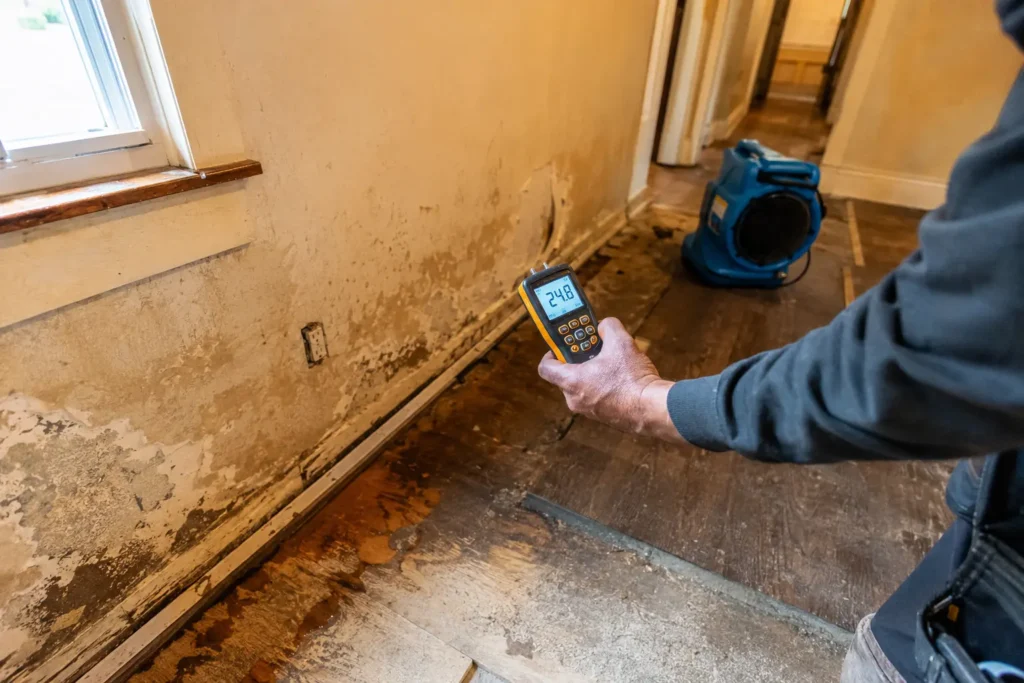
The problem is that “looks okay” is not the right standard for water damaged materials. What matters is moisture content and moisture hides inside materials that look completely fine on the surface. Drywall that tested at 40% moisture content feels the same to the touch as drywall at 15%, which is the threshold for safe drying. The only way to know the difference is a moisture meter reading, not a visual inspection.
In Peoria, where older housing stock and block foundations mean water often enters slowly and spreads widely before anyone notices, the gap between how damage looks and how bad it actually is tends to be significant. This is especially true in neighborhoods like West Central, East Bluff, and Bartonville, where homes built in the 1940s through 1960s have materials that absorb water differently from modern construction. This is why water damage repair Peoria IL jobs in older neighborhoods consistently involve more material removal than homeowners initially expect.
What Can Usually Be Repaired After Water Damage
Some materials handle water damage repair Peoria IL situations well enough to be dried in place without full replacement. The key word is “dried in place” – which requires professional equipment, documented moisture readings, and enough time for the material to fully release the absorbed moisture.
Materials that can often be repaired rather than replaced:
- Concrete and block foundations – concrete absorbs moisture but doesn’t degrade the way organic materials do. After extraction and structural drying, concrete and block foundations are typically restored without replacement.
- Solid wood framing – structural framing that was wet but dried within the first 48 to 72 hours and shows no signs of warping, cracking, or mold growth can usually be dried in place. It needs to reach moisture equilibrium before any new drywall or flooring goes over it.
- Tile and grout flooring – ceramic and porcelain tile doesn’t absorb water the way wood or carpet does. Tile floors that haven’t been subjected to prolonged submersion can often be dried, cleaned, and regrouted without full replacement.
- Painted walls without insulation – painted drywall that was wet for a short period, caught quickly, and dried professionally may be salvageable. This depends entirely on how long it was wet and whether the paper backing absorbed enough moisture to compromise the structural integrity of the board.
- Cabinetry – solid wood cabinets, as opposed to particleboard or MDF construction, can sometimes be dried and refinished rather than replaced, depending on the extent of swelling and the time water was in contact.
What Almost Always Gets Replaced After Water Damage
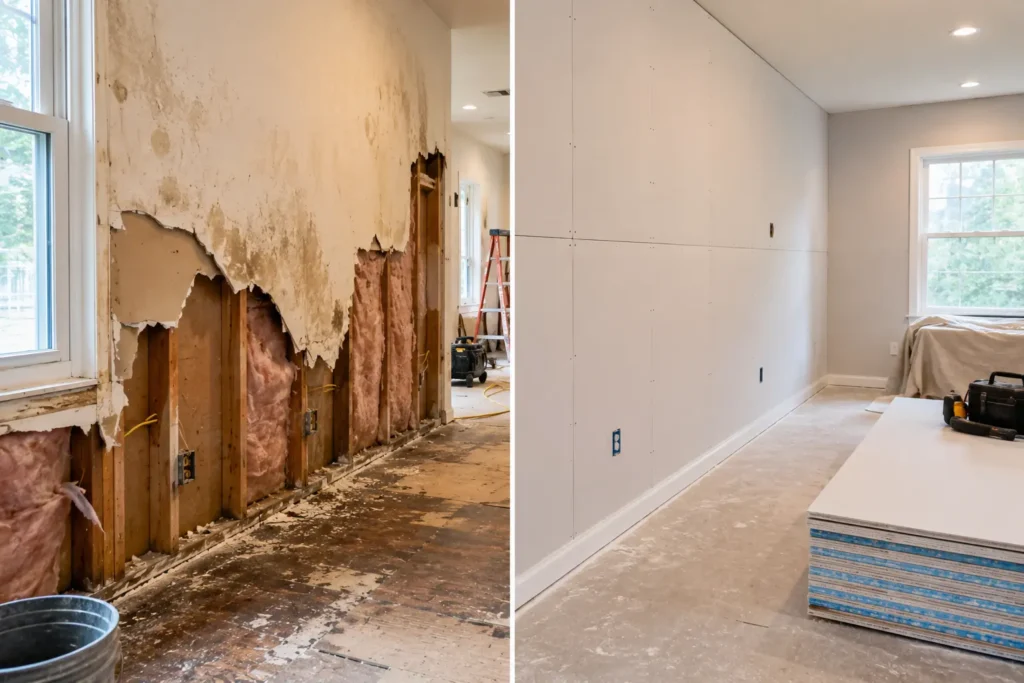
Other materials don’t survive water damage repair Peoria IL jobs intact – trying to dry these rather than remove them is where most long-term problems start. Trying to dry these materials rather than remove them is where most long-term mold and structural problems originate.
Materials that typically require replacement:
- Carpet and carpet padding – carpet padding holds water underneath the surface carpet, creating a moisture reservoir that household drying can’t reach. Even when the carpet surface feels dry, the padding below is often saturated. Both almost always need to go after a flooding event.
- Drywall below the water line – drywall paper absorbs water rapidly and provides an ideal surface for mold growth. Our drywall water damage repair process evaluates moisture readings at multiple points in every sheet, but any board that was submerged or that sustained prolonged contact with water typically gets removed. Keeping saturated drywall in place is the most common reason mold appears weeks after a seemingly successful drying job.
- Insulation inside wall cavities – fiberglass batt insulation that absorbs water loses its R-value and holds moisture against the framing for extended periods. Our wet insulation removal and replacement service removes compromised insulation as a standard step whenever wall cavities show elevated moisture readings, because drying insulation in place is rarely effective.
- Particleboard and MDF – these engineered wood products swell immediately on water contact and don’t return to their original dimensions when dried. Cabinets, shelving, and furniture made from these materials are almost always total losses after flooding.
- Hardwood flooring in most flooding situations – hardwood absorbs water and begins cupping and buckling within hours. Our water-damaged flooring removal service handles hardwood that has been submerged in a flooding event, which in most cases requires full replacement rather than refinishing.
The Role of Moisture Readings in Every Decision
Every fix versus replace decision in a water damage repair job should be backed by moisture meter data, not visual judgment. This is the standard the IICRC sets for restoration work, and it’s what separates a repair that holds up from one that fails in six months.
According to the EPA’s guidance on indoor moisture control, materials that remain above safe moisture thresholds for extended periods create conditions for mold growth regardless of how they look on the surface. This is why a professional moisture assessment before any repair decisions are made is not optional – it’s the data that drives every subsequent decision.
For Peoria homeowners dealing with flooded basement cleanup situations specifically, the fix versus replace decision is often more complex than above-grade flooding because basement materials are typically in contact with water longer before the flooding is discovered, and because block foundation walls create a different drying environment than framed above-grade walls. Moisture data is what makes every water damage repair Peoria IL decision defensible – without it, you’re guessing.
How Water Source Affects What Gets Replaced
The category of water involved changes the replacement calculus significantly. Clean water from a burst pipe gives materials the best chance of being dried and repaired. Greywater from appliance failures introduces contamination that may require additional decontamination before materials can be dried in place. Category 3 black water – sewage backup, river flooding, groundwater intrusion – contaminates every porous material it contacts, which means the replacement scope in a category 3 event is significantly larger than an equivalent clean water job.
For a detailed breakdown of what category 3 water events involve and why the cleanup approach differs, our sewage backup cleanup guide covers the contamination factors that drive material removal decisions in those situations.
Timeline – When Repair Is Possible vs When It’s Too Late
Time is the variable that turns water damage repair Peoria IL repairable situations into replacement situations. The longer water sits in contact with a material, the deeper it penetrates, the more the material degrades, and the higher the mold risk becomes.
General timeline for most materials in Peoria homes:
- 0 to 2 hours – most structural materials are still candidates for drying in place with professional equipment
- 2 to 24 hours – drywall, insulation, and wood framing begin absorbing beyond recoverable levels in many cases
- 24 to 48 hours – mold risk becomes active, and any material that hasn’t begun drying is increasingly likely to require replacement
- Beyond 48 hours – the scope of replacement expands significantly, and mold remediation becomes part of the job scope alongside repair
This timeline is why every hour between discovery and professional extraction matters, not just for limiting spread, but for keeping materials in the repairable category rather than the replace category.
Final Thought – The Right Answer Depends on the Data
There’s no universal answer to water damage repair Peoria IL – it depends on the material, the water source, how long water was present, and what moisture readings show.
What doesn’t work is making those decisions based on how things look. Water damage hides. Professional moisture assessment is what makes repair decisions defensible, and it’s what determines whether a repair lasts or fails.
For water damage repair Peoria IL response right now, call (309) 549-1827) – available 24/7 with same-day assessment across Peoria and surrounding Peoria County communities.
Leave a Reply