
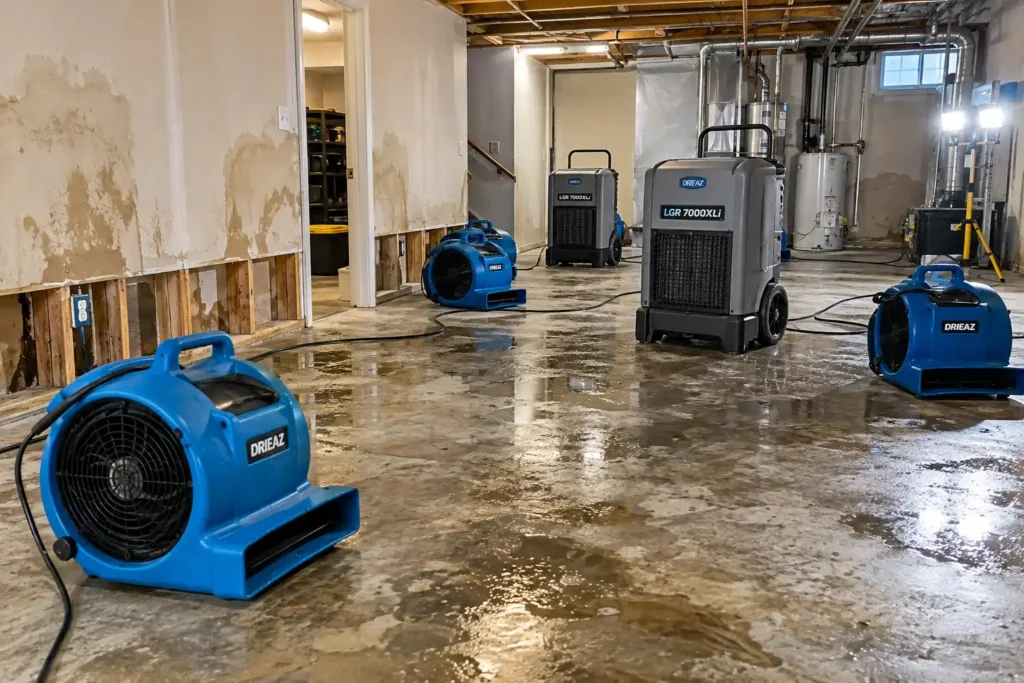
Structural drying Peoria IL homeowners need after a flooding event is the phase of water damage restoration that most people underestimate – and the phase that determines whether a restoration job succeeds or fails long term. Extracting standing water gets the visible problem out of sight. Structural drying addresses what remains inside walls, subfloor assemblies, ceiling joists, and foundation materials after the surface looks dry.
In Peoria’s climate specifically, structural drying is more challenging and takes longer than national averages suggest – and understanding why helps homeowners make smarter decisions about timelines, equipment, and what it means when a restoration company says the job is “done.”
What Structural Drying Actually Is – And What It Isn’t
Structural drying is the professional process of removing moisture from building materials – drywall, wood framing, concrete block, subfloor assemblies, insulation – using commercial-grade dehumidifiers and air movers calibrated to the specific materials and moisture levels present.
It is not the same as ventilation. Opening windows and running household fans moves surface air but does not extract moisture from inside structural materials. The moisture that matters – the moisture that causes mold, wood rot, and long-term structural degradation – is inside the material, not on the surface.
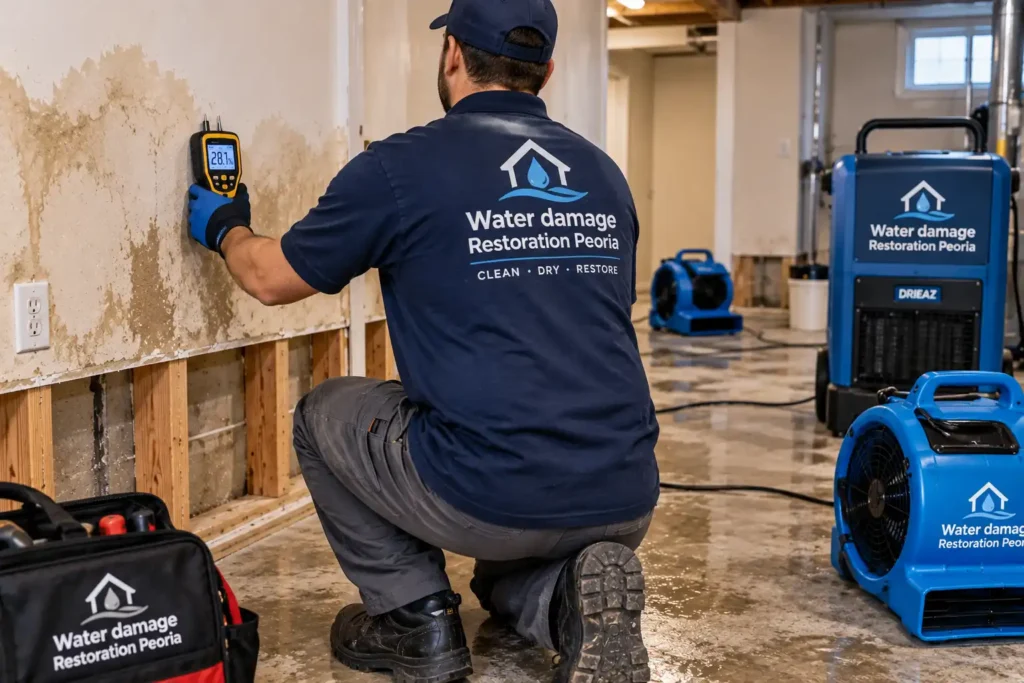
It is not complete when the surface feels dry. A wall that feels dry to the touch may still have moisture readings well above the safe threshold inside the wall cavity. Drywall that reads 12% moisture content on a pin meter may have framing behind it reading 28%, which is well into the mold-risk zone.
Structural drying Peoria IL professional process is complete only when calibrated moisture meters confirm all affected structural materials have returned to their equilibrium moisture content – the level consistent with the normal dry conditions of the local environment.
Why Peoria IL Makes Structural Drying More Difficult Than Most Regions
Structural drying Peoria IL jobs consistently take longer and require more equipment than equivalent jobs in drier regions, and the reasons are specific to Peoria’s geography and housing stock.
Illinois River influence on ambient humidity – Peoria sits along the Illinois River, and the water vapor contribution from the river combined with central Illinois’s humid continental climate keeps outdoor relative humidity consistently high from May through September. Commercial dehumidifiers work by drawing moisture out of materials and the surrounding air. When outdoor air being exchanged into the drying space carries its own high moisture load, dehumidifiers work against a continuously refreshed source of humidity that slows the drying process significantly.
Block foundation construction – Block foundation construction is one of the biggest factors in any structural drying Peoria IL job – older neighborhoods like West Central, East Bluff, and Bartonville have a high concentration of pre-1970s homes with concrete block foundations that hold moisture significantly longer than poured concrete. Block is porous and absorbs water readily, holding moisture in the block cells long after visible water has been extracted. Structural drying of block foundation walls requires more equipment run time and more monitoring than poured concrete or framed wall construction.
Clay-heavy soil moisture retention – Peoria County’s clay-dominant soil holds water against the foundation rather than draining it away. During and after a flooding event, this soil continues exerting moisture pressure against foundation walls and slab surfaces even after extraction is complete. Effective structural drying in these conditions has to account for this ongoing moisture source, not just the original water event.
These factors combined mean a structural drying job that would complete in 3 days in a dry inland climate may take 5 to 7 days in Peoria during summer flooding season – and that extended timeline is professional, not slow.
The Structural Drying Process – Step by Step in a Peoria Home
Structural drying Peoria IL professional process follows a consistent sequence regardless of the water source or the affected area of the home:
Step 1 – Moisture mapping before equipment placement
Before any drying equipment is placed, a full moisture assessment maps every affected material using thermal imaging and calibrated moisture meters. This mapping identifies which specific wall cavities, floor assemblies, and ceiling sections have elevated readings – including areas that show no visible damage on the surface. Equipment placement is driven by this map, not by where water was visually present.
Step 2 – Air mover placement
Commercial air movers get positioned at low angles against affected wall surfaces, creating high-velocity airflow that carries evaporated moisture away from wall and floor surfaces toward the dehumidifier intake. The number of air movers required per square foot depends on the materials involved and the moisture readings – denser materials like concrete block require more airflow for the same surface area than framed drywall construction.
Step 3 – Dehumidifier operation
Commercial dehumidifiers remove the moisture that air movers carry away from structural surfaces, extracting it from the air and collecting or draining it out of the space. Our desiccant dehumidification service uses desiccant-based units alongside refrigerant dehumidifiers for jobs where temperatures are lower or where very low final humidity levels are required – crawl space drying in spring, for example, where ambient temperatures may be too low for refrigerant units to operate at full efficiency.
Step 4 – Daily moisture readings
Every 24 hours, technicians return to check moisture readings at all monitored points across the affected area. Equipment gets repositioned as readings change – materials dry at different rates, and the drying front moves through the structure in ways that require equipment adjustment to follow. Daily documentation of these readings creates the moisture log that insurance adjusters need for claim processing.
Step 5 – Drying completion confirmation
Structural drying is considered complete when all monitored points reach their target moisture content – typically below 16% for wood framing and drywall, and within normal range for the specific material type. Final readings get documented before any equipment is removed or reconstruction begins.
How Long Does Structural Drying Take in Peoria IL?
Structural drying Peoria IL timelines vary based on several factors – the volume of water, the materials affected, the time between the water event and professional extraction, and the season.
General timelines for most Peoria residential structural drying jobs:
- Small contained event – single room, clean water source, professional extraction within 2 hours: 3 to 4 days
- Moderate flooding – basement or multiple rooms, water present for 6 to 12 hours before extraction: 5 to 7 days
- Major flooding event – whole-level flooding, Illinois River groundwater intrusion, or delayed response beyond 24 hours: 7 to 14 days
The single biggest variable extending these timelines in Peoria is outdoor humidity during the summer flooding season. Jobs started in October, when outdoor humidity is lower, typically complete faster than the same scope job started in June, when outdoor humidity remains high around the clock.
For basement flooding events specifically – which account for the majority of structural drying calls in Peoria – our flooded basement cleanup service includes daily moisture monitoring until all block foundation walls, concrete floors, and adjacent framing reach confirmed dry readings, regardless of how the timeline compares to averages.
Structural Drying and Mold – The 48-Hour Connection
The relationship between structural drying speed and mold risk is direct and well-documented. Mold spore germination on wet organic materials begins within 24 to 48 hours of moisture exposure. In Peoria’s summer conditions, where warm temperatures and high humidity create near-ideal conditions for mold growth, that window can be shorter.
Professional structural drying started within the first 2 hours of a water event significantly reduces the mold risk window. The same job started 24 hours after the event – because a homeowner was assessing, waiting for an insurance call, or attempting DIY drying first – starts with materials that have already been in the mold-risk window for the entire delay period.
According to the EPA’s guidelines on mold and moisture control, any porous material that has been wet for more than 24 to 48 hours should be evaluated for mold before being dried in place. This is why our structural drying process includes antimicrobial treatment applied before drying equipment is placed – not after drying is complete – on any job where materials were wet for more than a few hours before extraction started.
For Peoria homeowners who have already noticed musty odors after a flooding event, our mold remediation services can assess whether mold has established during the drying delay and what remediation scope is required before reconstruction begins.
Structural Drying in Crawl Spaces – The Most Overlooked Drying Challenge
Crawl space structural drying deserves specific attention because it’s the most consistently overlooked drying challenge in Peoria homes – and the one most likely to result in recurring mold and wood rot if not addressed properly.
Standard air mover and dehumidifier setups designed for above-grade residential drying don’t work as effectively in crawl spaces for several reasons. Crawl spaces have limited air volume, which means humidity saturates the space faster and needs to be replaced more frequently. Floor joist assemblies dry differently than wall assemblies, with the topside of the joist drying much faster than the underside. And crawl space access limitations mean equipment can’t always be positioned for optimal airflow.
Our crawlspace water extraction and drying service uses equipment specifically sized for confined space operation, with flexible ductwork to direct airflow to floor joist bays that standard units can’t reach directly. Daily moisture readings in crawl space jobs track the slowest-drying points – typically the center spans of floor joists and the soil beneath the vapor barrier – until all points reach safe levels.
Structural Drying and Insurance Documentation
Structural drying documentation is one of the most practically important deliverables of any professional drying job in Peoria, and it’s something homeowners should specifically request if it isn’t offered proactively.
Insurance adjusters reviewing water damage claims want to see a moisture log – daily readings at each monitored point, before and after equipment placement, showing the progression from wet to dry over the drying period. This documentation establishes that professional drying was performed to standard, that all affected areas were addressed, and that reconstruction didn’t begin over wet materials.
Without this documentation, insurance claims for reconstruction costs are harder to process and more likely to face disputes about whether the scope of reconstruction was justified. With it, adjusters can approve reconstruction scope based on documented evidence rather than visual assessment alone.
West Central and Older Peoria Neighborhoods – Why Structural Drying Takes Longer Here
The structural drying timeline in West Central and comparable older Peoria neighborhoods consistently runs longer than in newer construction areas, and the reasons are worth understanding for homeowners in these communities.
Pre-1970s construction uses denser, less porous drywall formulations than modern construction. Older wood framing is denser than modern lumber, which means it holds moisture longer but also releases it more slowly. Block foundation walls, common across West Central, East Bluff, and Bartonville, hold moisture in the block cells for significantly longer than poured concrete – sometimes extending drying timelines by two to three additional days compared to equivalent jobs in poured-foundation homes.
Structural drying Peoria IL jobs in these older neighborhoods require more equipment, longer run times, and more frequent monitoring than national average timelines suggest. That’s not a problem with the equipment or the process – it’s an accurate reflection of the materials being dried.
Final Thought – Structural Drying Peoria IL Is the Step That Makes Everything Else Work
Structural drying Peoria IL done correctly is what makes reconstruction last. Drywall installed over framing that reached 14% moisture content holds up. Drywall installed over framing that was still at 22% moisture content develops mold behind it within one to two seasons, requiring the reconstruction to be redone.
For homeowners who want to understand the full water damage process from beginning to end, our water mitigation guide covers the phase that comes before structural drying – and how mitigation quality directly affects how long drying takes.
For structural drying Peoria IL response right now, call (309) 549-1827 – available 24 hours a day, seven days a week, with same-day equipment placement and daily monitoring across Peoria and surrounding Peoria County communities.
Leave a Reply