
Hidden leak detection Peoria IL homeowners need is one of the most valuable – and most overlooked – services in water damage prevention. Most water damage restoration jobs we handle in Peoria trace back to a leak that was present for weeks or months before anyone noticed visible damage. By the time water staining appears on a ceiling or mold shows up on a basement wall, the leak has usually been saturating structural materials, feeding mold growth, and increasing in scope for far longer than anyone realized.
This guide covers how hidden leaks develop in Peoria homes, what the warning signs look like before visible damage appears, and what professional leak detection actually involves.
Why Hidden Leaks Are More Common in Peoria Homes Than Most Homeowners Realize
Peoria’s housing stock creates specific conditions that make hidden leaks more likely and harder to detect than in newer construction markets.
Older homes in neighborhoods like West Central, East Bluff, and Center Bluff were built with galvanized steel or cast iron plumbing that has been in place for 50 to 80 years. These materials corrode from the inside out – the exterior of the pipe looks intact while the interior has narrowed significantly from mineral buildup and corrosion. Pinhole leaks in galvanized pipes often start as slow seeps that saturate wall insulation and framing for months before breaking through to a visible surface.
Clay sewer laterals in pre-1970s Peoria construction develop root intrusion and cracking over time. Slow seepage from a compromised lateral can raise soil moisture against the foundation for years before it shows up as basement dampness or efflorescence on block walls.
Concrete slab homes in Peoria County, particularly in newer suburban areas, face a different version of the same problem – copper supply lines embedded in the concrete slab develop pinhole leaks from mineral corrosion and soil movement, releasing water under pressure directly into the slab where it migrates toward finished areas above.
Hidden leak detection Peoria IL is more relevant here than in newer construction markets simply because the age and construction type of the housing creates more locations where leaks can develop and travel undetected.
Warning Signs of a Hidden Leak – What to Look For
Hidden leak detection Peoria IL starts with knowing what signals to look for before visible water damage appears – most homeowners miss these early indicators entirely. Knowing what to look for allows detection weeks or months before structural damage becomes significant:
- Unexplained increase in water bills – a water meter that shows usage far above normal household consumption when no fixtures are running is the clearest indicator of an active leak somewhere in the supply system
- Musty odor in specific rooms – mold that develops inside wall cavities from a leaking pipe produces odor before it produces visible growth; a persistent musty smell in one room that doesn’t respond to ventilation is a reliable signal
- Warm spots on flooring – in homes with hot water supply lines running through or under slab floors, a slab leak in a hot water line creates warm areas on the finished floor above that are noticeably different from surrounding areas
- Sounds of running water – water movement sounds inside walls when no fixtures are in use indicate an active supply line leak
- Efflorescence on basement walls – the white mineral deposits that appear on concrete and block walls are left behind when water migrates through the wall material and evaporates on the surface
- Soft spots in flooring – subfloor deterioration from a long-running leak under finished flooring shows as soft, spongy areas underfoot that weren’t present previously
- Ceiling stains that reappear after painting – a stain that comes back after being painted over indicates an active moisture source above, not a past event
The EPA’s WaterSense program estimates that household leaks can waste nearly 10,000 gallons of water per year – making early detection both an environmental and financial priority.
Any one of these signs warrants investigation. Several occurring together in proximity indicate an active leak that needs to be located before the damage scope expands further.
How Professional Hidden Leak Detection Works
Hidden leak detection Peoria IL professional assessment uses several methods depending on where the leak is suspected:
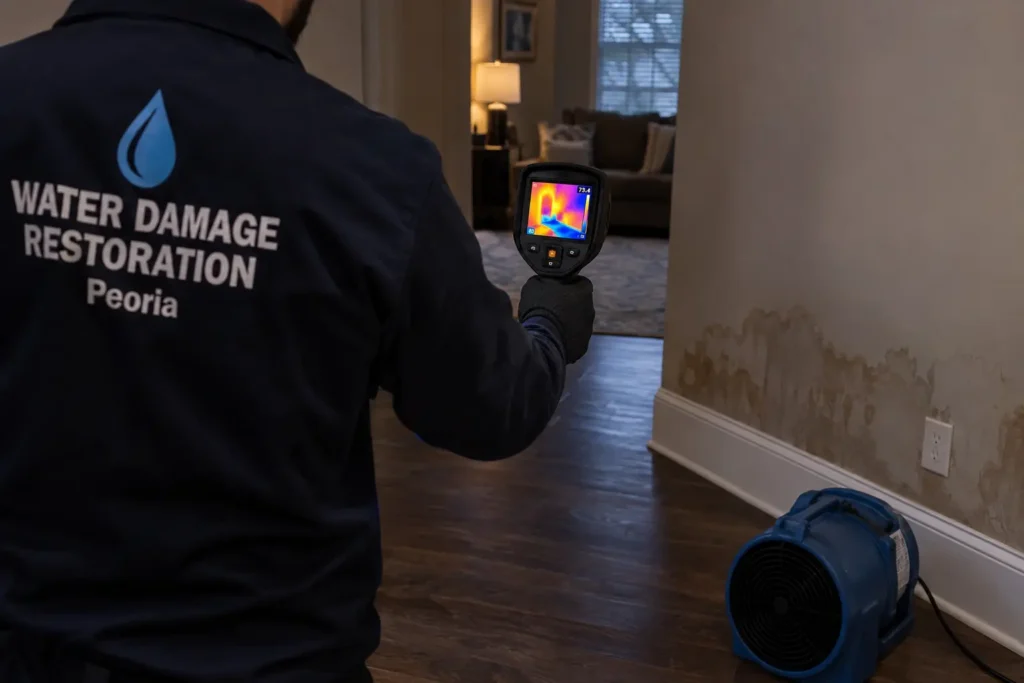
Thermal imaging – infrared cameras detect temperature differences in wall and ceiling surfaces that indicate moisture presence. Water-saturated materials hold temperature differently than dry materials, creating a thermal signature that’s visible on camera even when the wall surface looks completely normal. This is the most common first-step tool in hidden leak detection because it can cover large areas quickly without any wall intrusion.
Acoustic leak detection – specialized listening equipment amplifies the sound of water moving through pipes under pressure. Acoustic detection is particularly effective for identifying slab leaks and underground pipe leaks where the leak location needs to be pinpointed before any excavation or concrete cutting begins.
Moisture meter mapping – calibrated moisture meters measure moisture content inside wall cavities, subfloor assemblies, and structural framing without requiring wall access. A moisture map of an affected area identifies which specific zones have elevated readings, which guides both the leak source investigation and the scope of any subsequent repair.
Water meter testing – a simple but reliable test: recording water meter readings with all fixtures off and checking again after 30 to 60 minutes. Movement in the meter confirms an active leak somewhere in the supply system. This test doesn’t locate the leak but confirms one exists before investing in further detection methods.
Our pipe leak detection and cleanup service starts with a full assessment using these methods before any repair work begins, because locating the leak precisely is what determines whether repair requires wall access, concrete cutting, or simply fixing a connection at an accessible point.
Slab Leaks – The Most Damaging Hidden Leak Category in Peoria
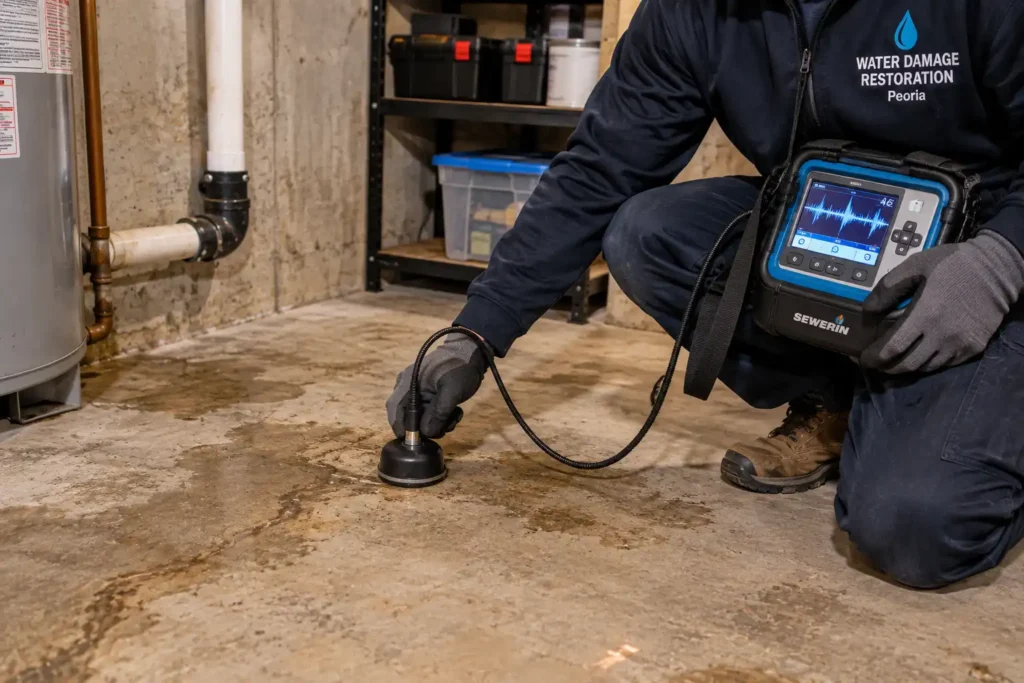
Slab leaks are the most damaging category in any hidden leak detection Peoria IL job – expensive to repair and among the hardest to locate without professional equipment.
A slab leak occurs when a water supply or drain line embedded in or running under a concrete slab develops a leak. The water released under the slab has nowhere obvious to go – it migrates through the concrete and finds paths upward through cracks, control joints, and the interface between the slab and interior walls. By the time any surface indication appears – warm floors, wet spots on carpet, or visible moisture at wall bases – the leak has often been running long enough to create significant moisture under the slab.
In Peoria County’s clay-heavy soil, slab movement from seasonal freeze-thaw cycles and moisture expansion is more pronounced than in stable soil environments. This movement stresses embedded copper lines at their connections and bends, which is where slab leaks most commonly originate.
Our slab leak detection and repair service uses acoustic detection equipment to pinpoint the leak location within the slab before any concrete cutting begins, which minimizes the disruption and cost of access compared to exploratory cutting without location confirmation.
What Happens When a Hidden Leak Goes Undetected
The damage progression from an undetected hidden leak follows a consistent pattern. Understanding the timeline helps explain why detection before visible damage appears is so much more valuable than detection after:
Weeks 1 to 4 – moisture saturates insulation and framing inside wall cavities. No visible surface indication. Water bill may show slight increase depending on leak volume.
Weeks 4 to 8 – mold spores begin germinating on saturated organic materials inside wall cavities. Musty odor may become detectable in affected rooms. Insulation compresses from moisture absorption and loses R-value.
Weeks 8 to 16 – visible mold may appear at wall bases, ceiling seams, or other low-resistance exit points. Drywall paper begins to delaminate. Wood framing shows early-stage deterioration.
Beyond 4 months – structural framing, subfloor material, and finish surfaces show active deterioration. Mold remediation is now required alongside pipe repair and water damage restoration. Total scope and cost are significantly higher than detection at the 4-week mark would have required.
A hidden leak detected within the first month typically requires pipe repair, drying, and perhaps insulation replacement. The same leak detected at month four often requires pipe repair, mold remediation, drywall replacement, flooring removal, and structural assessment. For a full breakdown of what water damage repair involves at that stage, our water damage repair guide covers the fix versus replace decision process – the same decisions that hidden leak detection Peoria IL early response is designed to prevent.
Burst Pipes and the Hidden Leak Connection
Not all pipe failures are dramatic. A burst pipe from freezing temperatures during a Peoria winter often gets attention immediately because of the volume of water involved. But the freeze events that cause full bursts also cause micro-cracks and weakened joints in sections of pipe that didn’t fully fail – and those sections become hidden leak sources over the weeks following the original event.
Peoria’s freeze-thaw cycles between December and March create multiple freeze risk events in a single winter. A pipe that survived January without bursting may have developed stress cracks that become active leaks by April – timed almost exactly with Illinois River flooding season, when homeowners are focused on basement water rather than pipe integrity.
Our burst pipe damage cleanup service includes an assessment of adjacent pipe sections for stress damage, not just the failed section, because addressing only the obvious failure while leaving compromised sections in place creates the conditions for the next leak event.
Water Damaged Flooring – The Visible End of a Hidden Leak
When a hidden leak detection Peoria IL inspection finds moisture at floor level, flooring is almost always the first finished surface showing visible deterioration from a leak that has been active much longer. Subfloor moisture that has been accumulating from a hidden pipe leak above or below floor level shows as soft spots, buckling hardwood, tile cracking at grout lines, or carpet that stays damp without an obvious source.
By the time flooring shows these signs, the subfloor beneath has typically been wet long enough to require professional drying or removal. Our water-damaged flooring removal service assesses both the finish flooring and the subfloor condition before any replacement decisions are made, because installing new flooring over a wet or compromised subfloor reproduces the same problem within one to two seasons.
Hidden Leak Detection in East Peoria and Surrounding Communities
Our hidden leak detection team serves Peoria and surrounding communities including East Peoria, West Central, Bartonville, Dunlap, North Florence, and Peoria Heights. For East Peoria specifically, where a mix of older bungalow construction and newer suburban development creates varied pipe age and material profiles, leak detection needs range from galvanized pipe assessment in pre-1970s homes to slab leak investigation in newer construction on expansive clay soil.
Final Thought – Hidden Leak Detection Peoria IL Costs Less Than the Alternative
Hidden leak detection Peoria IL professional assessment is significantly less expensive than the water damage restoration job that follows an undetected leak. The detection cost is fixed. The restoration cost scales with how long the leak ran before it was found.
For Peoria homeowners who have noticed any of the warning signs described in this guide – unexplained water bills, persistent odors, warm floor spots, or soft flooring – the right next step is detection, not waiting to see if the problem becomes more obvious.
For hidden leak detection Peoria IL response right now, call (309) 549-1827 – available 24 hours a day, seven days a week, with same-day assessment and thermal imaging inspection across Peoria and surrounding Peoria County communities.
Leave a Reply