
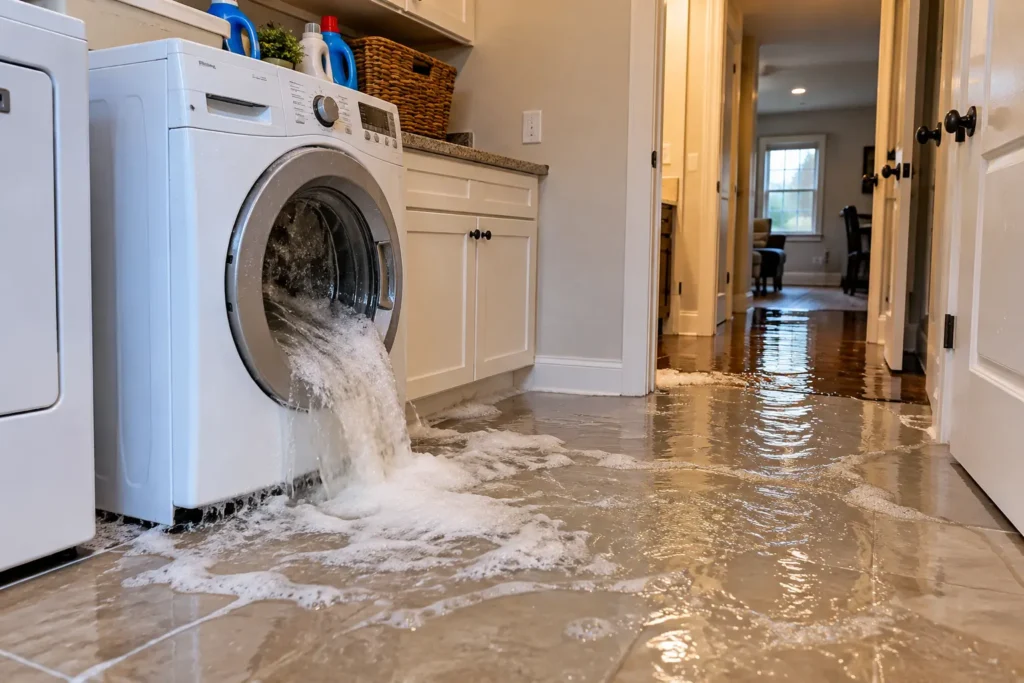
Appliance water damage Peoria IL homeowners deal with year-round is one of the most common and most underestimated water damage categories. Unlike flooding from the Illinois River or a burst pipe, appliance failures don’t announce themselves. A washing machine supply hose that’s been slowly weakening for years fails while the machine is running and the family is out. A water heater tank corrodes from the inside over months before the bottom finally gives way. A dishwasher door seal fails silently, releasing water under the kickplate and into the subfloor with every wash cycle.
By the time any of these events become visible, the water has already been traveling for some time. This guide covers the three most common appliance water damage sources in Peoria homes, what the damage pattern looks like for each, and what the correct response involves.
Why Appliance Water Damage Is Different From Other Water Events
Appliance water damage Peoria IL situations have a specific characteristic that makes them different from storm flooding or pipe bursts – the water source is clean, pressurized, and often runs undetected for an extended period before anyone discovers the event.
A burst pipe from a freeze event is dramatic. Water comes out under full line pressure and makes its presence known quickly. An appliance leak is often the opposite – a slow release from a failed seal, a pinhole in a supply hose, or a corroded tank bottom that releases water gradually over hours or days.
The damage pattern that results from this gradual release is significant. Water that enters under a dishwasher or behind a washing machine doesn’t pool visibly on the surface immediately – it travels under the appliance, through the floor covering, into the subfloor, and along floor joists into adjacent rooms before it appears anywhere that anyone would notice. By the time a wet spot shows up on a ceiling below a second-floor laundry room, the subfloor between the floors has typically been wet for the full period since the failure began.
Washing Machine Water Damage – The Most Common Appliance Failure in Peoria Homes
Our washing machine overflow cleanup calls are among the most frequent appliance water damage situations we handle in Peoria and the most variable in terms of damage scope.
Washing machine water damage comes from three distinct failure points, each with a different damage pattern:
Supply hose failure – the hot and cold water supply hoses that connect the machine to the wall valves are the highest-risk component in most Peoria laundry setups. Standard rubber hoses degrade over time from pressure cycling, temperature variation, and age. A hose that fails under full line pressure releases water continuously until someone shuts off the supply valve or the main. In a laundry room on an upper floor, a full supply hose failure can release significant water volume before the homeowner returns home or hears anything from another room.
Drain line overflow – if the drain hose isn’t properly secured in the standpipe, the machine’s spin cycle can pump water out onto the floor rather than down the drain. This type of overflow is episodic – it happens during each wash cycle – and often goes unnoticed because the volume is smaller and the wet area dries between cycles, masking the fact that the subfloor beneath is accumulating moisture with each event.
Door seal failure (front-loaders) – front-loading washing machines are common in Peoria homes, and the rubber door gasket that seals the drum is a consistent failure point. A damaged or degraded door seal releases water during the wash cycle in a pattern that flows under the machine and into the floor covering beneath it. Because the water exits through the door rather than from a connection point, it’s often not noticed until visible staining appears on the floor covering.
In all three scenarios, the subfloor beneath the washing machine is the primary structural concern. Repeated moisture exposure from a slow drain overflow or door seal failure, even at low volumes, creates cumulative moisture accumulation that drives mold growth inside the floor assembly over time.
Dishwasher Water Damage – What’s Happening Under the Kickplate
Dishwasher water damage in Peoria homes is the appliance failure most likely to be going on right now without anyone knowing. The dishwasher sits in a cabinet enclosure with a kickplate across the bottom that hides everything happening beneath the unit – which is exactly where water from a failing door gasket, a compromised drain hose, or a cracked pump housing ends up.
Our dishwasher overflow cleanup service regularly uncovers significant subfloor damage in kitchens where the homeowner had no idea there was a problem. The sequence is consistent: water releases during the wash cycle, flows under the kickplate, soaks into the wood subfloor beneath the tile or hardwood, and begins wicking outward under the cabinet base. The subfloor dries partially between cycles but never fully – and over weeks to months, the cumulative moisture level crosses the threshold for mold growth.
Common dishwasher failure points in Peoria homes:
- Door gasket deterioration – the rubber seal around the dishwasher door flattens and cracks with age, allowing water to escape around the door during wash cycles
- Drain hose connection failures – the connection between the dishwasher drain hose and the garbage disposal or drain line under the sink loosens over time, particularly if the connection uses a clamp that hasn’t been tightened since installation
- Water inlet valve failure – the valve that controls water flow into the dishwasher can fail open, allowing water to continue entering the unit even when it shouldn’t
The visible signal that most homeowners eventually notice is buckled hardwood or warped laminate flooring in front of the dishwasher – by which point the subfloor beneath has been wet long enough to require assessment and likely replacement rather than simple drying.
Water Heater Failure – The Peoria Appliance Damage Event With the Largest Footprint
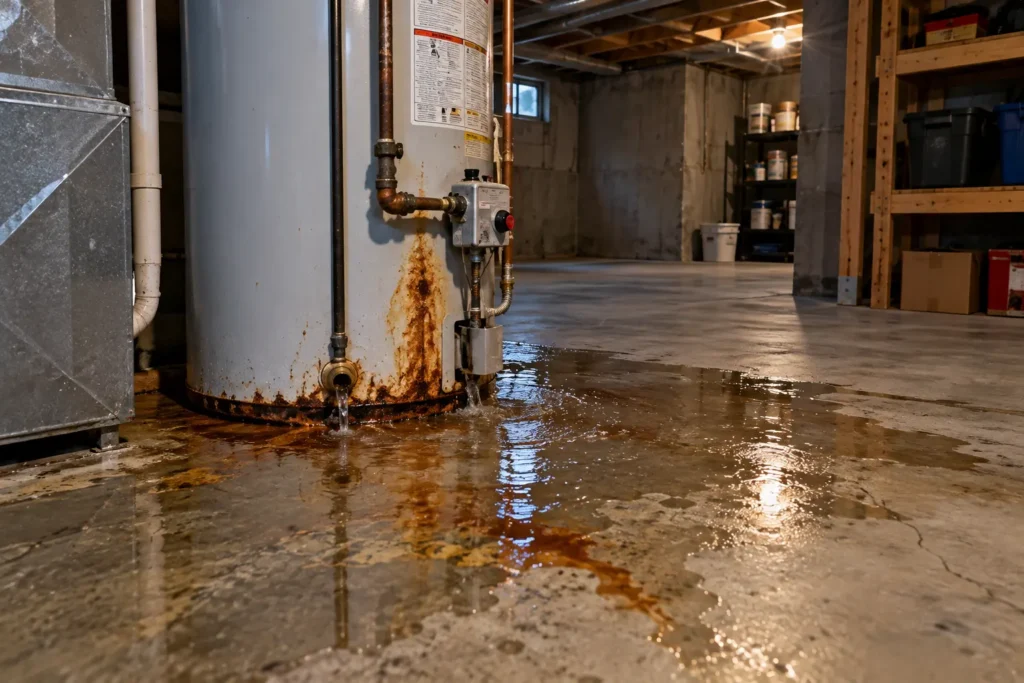
A water heater tank failure is the single highest-volume appliance water damage event a Peoria home can experience. The average residential water heater holds 40 to 80 gallons of water. When a tank fails catastrophically – through a corroded bottom, a failed pressure relief valve, or a structural failure from internal corrosion – that entire volume releases into whatever space the tank occupies, typically the basement or a utility closet.
In Peoria’s older housing stock, where many homes have 40 or 50-year-old natural gas water heaters that were never replaced, tank failure is a consistent source of significant basement water damage. The interior corrosion process that leads to failure is invisible from the outside – a tank that looks intact and functions normally can have an interior that’s heavily corroded and weeks away from failure.
Water heater failures also create a secondary complication that other appliance failures don’t: the water released is hot. Hot water accelerates moisture absorption into structural materials and increases the rate of material saturation compared to cold water events at the same volume. It also creates vapor that distributes humidity throughout the affected space, which contributes to mold growth risk in areas beyond the primary water contact zone.
Our appliance leak cleanup process for water heater failures starts with temperature confirmation – entering a space that has experienced a large-volume hot water release has hazard considerations beyond standard flooding events.
Refrigerator Water Line Leaks – The Slow Event With Big Consequences
Refrigerator ice maker and water dispenser lines are a source of slow, chronic water damage that often goes undetected for months. The supply line to a refrigerator runs from the wall connection behind the unit, typically along the floor under the appliance, where it’s completely hidden from view.
When this line develops a pinhole leak or a connection loosens, water releases in small volumes onto the floor beneath the refrigerator – which is covered by the appliance itself and not visible without pulling the unit out. The water soaks into the flooring and subfloor, which is the same flooring that extends to visible areas of the kitchen where there’s no obvious wet spot.
Our refrigerator water line leak repair service includes a full moisture assessment of the subfloor and adjacent floor areas before any repair or restoration work begins – because the subfloor damage from a refrigerator line leak almost always extends significantly further than the footprint of the appliance itself.
What Appliance Water Damage Does to Flooring and Subfloor
Flooring is consistently the most visible and most significantly affected material in appliance water damage events. The damage pattern differs by floor covering type:
Hardwood flooring – absorbs water and begins cupping within hours of exposure. Boards that cup from a single wet event may flatten when dried, but repeated moisture exposure from a slow appliance leak creates permanent dimensional change that requires full replacement. Hardwood over a wet subfloor continues absorbing moisture from below even after the surface water source is stopped.
Tile and grout – the tile itself doesn’t absorb water, but grout lines do, and the adhesive layer and subfloor beneath are often plywood or OSB that saturates readily. Tile that looks undamaged on the surface may be sitting over a wet subfloor that requires removal to dry effectively.
Laminate and LVP – both products are sensitive to sustained water contact. Laminate swells at the edges and joints on water contact. LVP handles short-term moisture better but will release from the subfloor adhesive under sustained moisture from below.
Our water-damaged flooring removal service assesses both the finish flooring and subfloor condition before any replacement decisions are made. Installing new flooring over a wet subfloor reproduces the same damage within one to two seasons.
What to Do Immediately After Discovering an Appliance Water Leak
Appliance water damage Peoria IL response in the first hour follows the same priorities regardless of which appliance failed:
Stop the water source – turn off the supply valve for the specific appliance if accessible, or shut off the main if the valve can’t be located quickly. For washing machine failures, the supply valves are typically behind or beside the machine. For dishwashers, the supply valve is usually under the adjacent sink. For water heaters, the cold water inlet valve at the top of the tank.
Don’t run the appliance again – do not run another wash cycle to “test” whether the problem is resolved before a professional assessment has identified the failure point.
Document before cleanup – photograph the extent of water spread, the appliance condition, and any visible flooring or wall damage before any items are moved or any water is absorbed.
Call for professional extraction – household towels and a wet vac can remove surface water from accessible areas, but the subfloor moisture that represents the actual structural damage requires commercial equipment to extract. The visible puddle is a fraction of the total moisture event.
For Peoria homeowners who want to understand what hidden moisture from a slow appliance leak might already have done to the structure before it became visible, our hidden leak detection guide covers the warning signs and detection methods in detail.
Appliance Water Damage and Insurance in Illinois
Standard Illinois homeowner’s insurance covers sudden and accidental appliance water damage. The key word is sudden – a washing machine supply hose that fails and releases water in a single event is covered. A dishwasher door seal that has been slowly leaking for six months before the damage becomes visible may face a gradual damage exclusion that limits or denies coverage.
This distinction matters for how appliance water damage events are documented. If there’s any possibility the damage accumulated over time rather than occurring in a single event, the documentation of when the failure was discovered and what condition the appliance and flooring were in before the event becomes critical to how the claim is processed.
According to the Illinois Department of Insurance, insurers processing water damage claims are required to document their coverage determination in writing. If a claim is denied under the gradual damage exclusion, homeowners have the right to request the specific policy language that applies.
Bellevue and Surrounding Peoria Neighborhoods – Appliance Age and Risk
In established Peoria neighborhoods like Bellevue, West Central, and East Bluff, the housing stock includes a significant number of homes with older appliances that have been in place for 15 to 25 years. Washing machine supply hoses, water heater tanks, and dishwasher door gaskets all have finite service lives – and older appliances in homes that have had the same owners for decades often haven’t had these components replaced.
A rubber supply hose that’s 15 years old is a failure event that hasn’t happened yet, not a component that’s been inspected and confirmed safe. Proactive replacement of aging supply hoses, annual water heater anode rod inspection, and periodic dishwasher gasket assessment are the practical steps that prevent appliance water damage events before they occur.
Final Thought – Appliance Water Damage Peoria IL Starts Before You See It
Appliance water damage Peoria IL situations almost always start before the homeowner knows about them. The washing machine hose fails while the family is away. The dishwasher leaks under the kickplate for weeks before a floor bubble appears. The water heater corrodes from the inside for months before the bottom gives out.
What determines the total outcome is what happens in the first hour after discovery – stopping the water source, documenting conditions, and calling for professional extraction before the moisture spreads further into subfloor and adjacent structural materials.
For appliance water damage Peoria IL response right now, call (309) 549-1827 – available 24 hours a day, seven days a week, with same-day extraction and assessment across Peoria and surrounding Peoria County communities.
FAQ Section
Q1: Does homeowner’s insurance cover appliance water damage in Peoria IL?
Standard Illinois homeowner’s insurance covers sudden and accidental appliance water damage – a washing machine hose that fails and releases water in a single event, a water heater tank that ruptures, or a dishwasher that overflows due to a mechanical failure. Gradual leaks that developed over time and caused damage before being discovered may face coverage limitations under the gradual damage exclusion. Documenting when the failure was discovered and the condition of the appliance is important for claim processing.
Q2: How much damage can a washing machine overflow cause in a Peoria home?
The scope depends on how long the water ran before it was discovered and which floor the laundry is on. A supply hose failure on an upper-floor laundry room can affect the subfloor, ceiling of the room below, and adjacent rooms before being discovered. The visible damage is consistently smaller than the actual structural moisture scope – moisture mapping after extraction almost always reveals wet materials beyond what’s visible on the surface.
Q3: How do I know if my dishwasher has been leaking without me knowing?
Common indicators of a slow dishwasher leak include soft spots in the flooring in front of or beside the dishwasher, discoloration or buckling in hardwood or laminate near the unit, musty odors in the kitchen that don’t respond to ventilation, and cabinet base material that shows water staining or swelling. Pulling the dishwasher out and inspecting the floor beneath it is the most direct way to assess whether a slow leak has been occurring.
Q4: What’s the most common cause of water heater failure in Peoria homes?
Internal tank corrosion is the most common cause of water heater tank failure. The anode rod inside the tank is designed to corrode in place of the tank itself – when it’s depleted, the tank begins corroding directly. Water heaters in Peoria’s older housing stock that haven’t had anode rod inspections or replacements are at elevated failure risk, particularly tanks that are 10 or more years old. The exterior of the tank provides no indication of internal corrosion status.
Q5: Can I dry out appliance water damage myself?
Surface water in accessible areas can be absorbed with towels and a wet vac – but the subfloor moisture that represents the primary structural damage from appliance failures requires commercial extraction equipment to address. Household drying tools move surface air but can’t pull moisture out of subfloor assemblies, floor joist cavities, or cabinet base materials. The subfloor damage that leads to mold and structural deterioration develops from moisture that household equipment leaves behind.
Q6: How long does appliance water damage cleanup take?
Timeline depends on the volume of water released, how long the event ran before discovery, and what materials were affected. Small contained appliance overflows caught quickly can complete extraction and drying in three to five days. Events involving subfloor saturation, multi-room spread, or upper-floor appliances that affected lower ceilings typically run one to two weeks for extraction, drying, and material removal – with reconstruction following after drying is confirmed complete.
Leave a Reply