
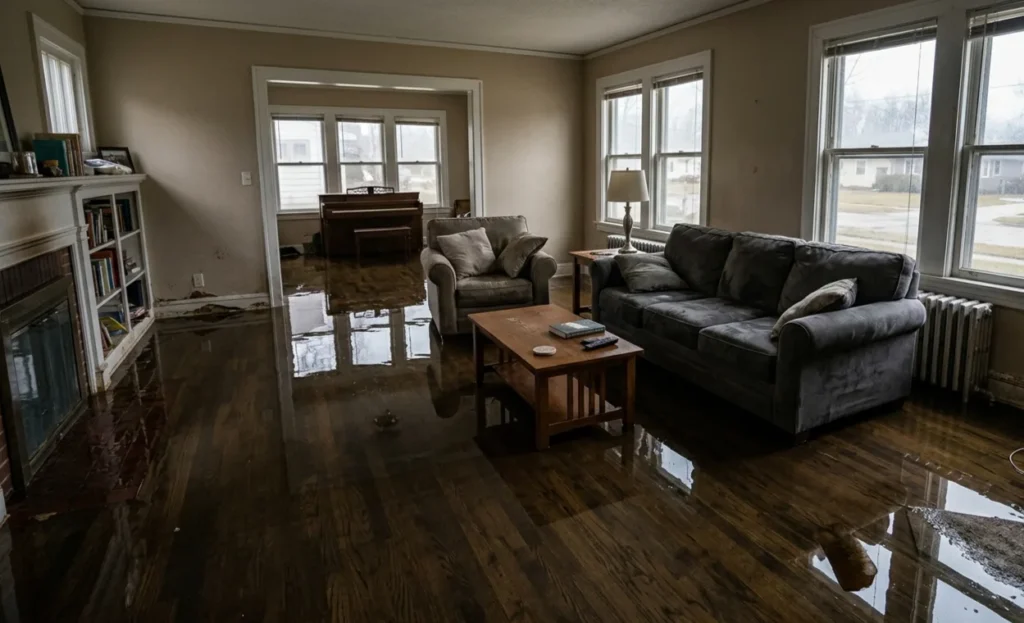
Flood cleanup Peoria IL homeowners deal with this every spring, and the first 24 hours after a flooding event are the most important hours in the entire restoration process. What you do, or don’t do, during this window directly determines whether you’re looking at a manageable cleanup job or a full mold remediation and reconstruction situation three weeks from now.
This guide covers exactly what to do, in order, from the moment you discover standing water in your home.
Why the First 24 Hours Matter More Than Anything Else
If flood cleanup Peoria IL extraction has started within the first day, here’s what the next week typically looks like for most Peoria homes. Water doesn’t sit still. From the moment it enters your home, it’s moving, spreading through flooring, soaking into drywall, wicking up into wall insulation, and migrating toward every porous material it can reach. Within two hours of a flooding event, water that entered through your basement has often already reached the subfloor above it.
Within 24 to 48 hours, mold spores that are always present in the indoor environment begin to activate and colonize any wet material. Once that happens, the job changes from water damage cleanup to mold remediation, and that difference shows up directly in your total restoration cost.
The Illinois River flooding season in Peoria runs March through June every year. Homes near the river, in neighborhoods like Bartonville and West Central, see this pattern repeat annually. The homeowners who come out of it with the lowest costs and the fastest recovery are consistently the ones who started professional extraction within the first few hours, not the next morning. This is exactly why flood cleanup Peoria IL professionals emphasize same-day extraction over waiting to assess the situation first.
Step 1 – Make Sure It’s Safe to Enter
Before you touch anything, the first check is electrical safety. Floodwater and live electricity in the same space is a life-threatening combination, and it happens more than most people realize when water reaches outlet height or contacts a panel box.
If you’re not certain the power to the affected area has been shut off at the breaker, don’t enter until you’ve confirmed it. Call your utility company if needed. This is not a step to skip because you’re worried about the floors getting more damaged.
Once electrical safety is confirmed, check for structural issues. Doors that won’t open or close properly, visible wall cracks, or ceilings that look bowed are signals to stay out until a professional assesses the structure. In any flood cleanup Peoria IL situation, electrical safety comes before everything else – no exception.
Step 2 – Document Everything Before Moving Anything
Proper documentation is one of the most overlooked parts of flood cleanup Peoria IL homeowners face when filing insurance claims. Your insurance claim depends on documentation. Take photos and video of every affected room, every piece of damaged furniture, every wet wall, every ruined floor, before you move a single item or touch a surface.
Walk through the entire affected area and document:
- Standing water level on walls, baseboards, and doorframes
- All furniture, appliances, and belongings that are wet or damaged
- Visible damage to flooring, drywall, and ceiling if applicable
- The exterior source if visible, roof damage, foundation crack, or storm drain backup
Insurance adjusters reviewing claims want to see the pre-cleanup condition. Photos taken after you’ve already moved things out are far less useful than photos taken the moment you discovered the flooding.
Step 3 – Call for Professional Extraction Immediately
This is the step most Peoria homeowners delay and in any flood cleanup Peoria IL job, it’s the decision that affects everything else. Either because they’re trying to assess the situation first, or because they think a wet vac and some fans can handle it. Both cost you significantly in the end.
Household equipment removes surface water. It does not extract moisture from inside wall cavities, subfloor material, or concrete block foundations. Commercial extraction equipment, the truck-mounted systems professional restoration teams use, pulls water out of structural materials that household tools can’t reach.
Our flood damage cleanup service starts with full moisture mapping of the affected area using thermal imaging and moisture meters, so every wet zone gets identified before equipment is placed, not discovered three days later when readings don’t improve.
Every hour you wait between flooding and professional extraction is an hour of additional material saturation. On a practical level, a job that starts extraction within two hours of flooding costs less and takes fewer days than the same job started twelve hours later.
Step 4 – Move Salvageable Belongings Out of the Wet Zone
Once professional extraction is underway or confirmed to be arriving shortly, start moving anything that can be saved out of the affected area. Prioritize:
- Documents, photos, and irreplaceable items first
- Electronics, moved carefully and not powered on until fully dry
- Furniture that can be lifted, placed on blocks, or moved to a dry room
- Rugs and area carpets, which can be dried separately if caught quickly
Carpet padding is almost always a total loss in a flood situation. It absorbs and holds water that the carpet above it may not visibly show, making it a primary mold risk if left in place. Your restoration team will advise on what’s worth attempting to save versus what needs to go.
For homeowners dealing with a flooded basement cleanup specifically, the priority list is slightly different. Water heaters and HVAC equipment in the basement should be evaluated by a licensed technician before being powered back on after submersion. Moving belongings out quickly is a basic but critical part of any flood cleanup Peoria IL recovery process.
Step 5 – Contact Your Insurance Company
Call your insurance company the same day, not after the cleanup is underway. Your policy may have specific requirements about timing of notification, and missing that window can affect your claim.
When you call, have ready:
- Your policy number
- The date and approximate time flooding began
- The suspected source, burst pipe, storm flooding, appliance failure, sewer backup
- Your documentation photos and video
According to FEMA’s National Flood Insurance Program guidelines, standard homeowner’s insurance does not cover flooding from external sources like the Illinois River or groundwater intrusion. If your flooding came from outside the home rather than from an internal plumbing failure, you’ll need to file through a separate flood insurance policy if you have one.
This is an important distinction for Peoria homeowners, because a significant portion of the flooding events in this area, particularly those caused by Illinois River surges or groundwater rise, fall into the category that standard policies exclude.
Step 6 – Don’t Ventilate With Outside Air During Summer Months
This one surprises people. The instinct when your home floods is to open every window and door to let things dry out. During Peoria’s humid summer months, May through September, outside air is often more humid than the air inside your home, which means opening windows actually slows the drying process and can extend the mold risk window.
Professional drying uses sealed dehumidification, keeping the affected space closed while commercial dehumidifiers lower the relative humidity inside to a level that pulls moisture out of structural materials. Our burst pipe damage cleanup and flood jobs in Peoria both follow this sealed drying protocol, particularly during the months when outdoor humidity is consistently high.
Opening windows is reasonable in winter and early spring when outdoor air is dry. During summer flooding events, leave it to the equipment.
What Happens After the First 24 Hours
If professional extraction has started within the first day, here’s what the next week typically looks like for most Peoria homes:
- Days 2 to 3 – Structural drying continues, daily moisture readings tracked
- Days 4 to 5 – Readings drop into acceptable range for most materials
- Day 6 onward – Material removal for anything that didn’t dry, drywall, insulation, subfloor sections
- Week 2 – Reconstruction planning begins once all moisture readings confirm dry
The total timeline from extraction to completed restoration runs four to six weeks for most residential flood jobs in Peoria. Jobs where extraction was delayed past the first 24 hours, or where mold established before drying began, typically run longer and cost more.
Final Thought – Speed Is the Variable You Control
Most of what happens during a flood, the water source, the volume, the materials affected, is outside your control. What you can control is how fast professional help gets started. In Peoria, that decision is the single biggest factor in how your total restoration unfolds.
If you’re dealing with flooding right now anywhere in the Peoria area, including communities like Bartonville and surrounding Peoria County neighborhoods, call (309) 549-1827. Our team is available 24 hours a day, seven days a week, and we can have extraction equipment on site the same day. For immediate flood cleanup Peoria IL response, don’t wait – every hour counts.
Leave a Reply