
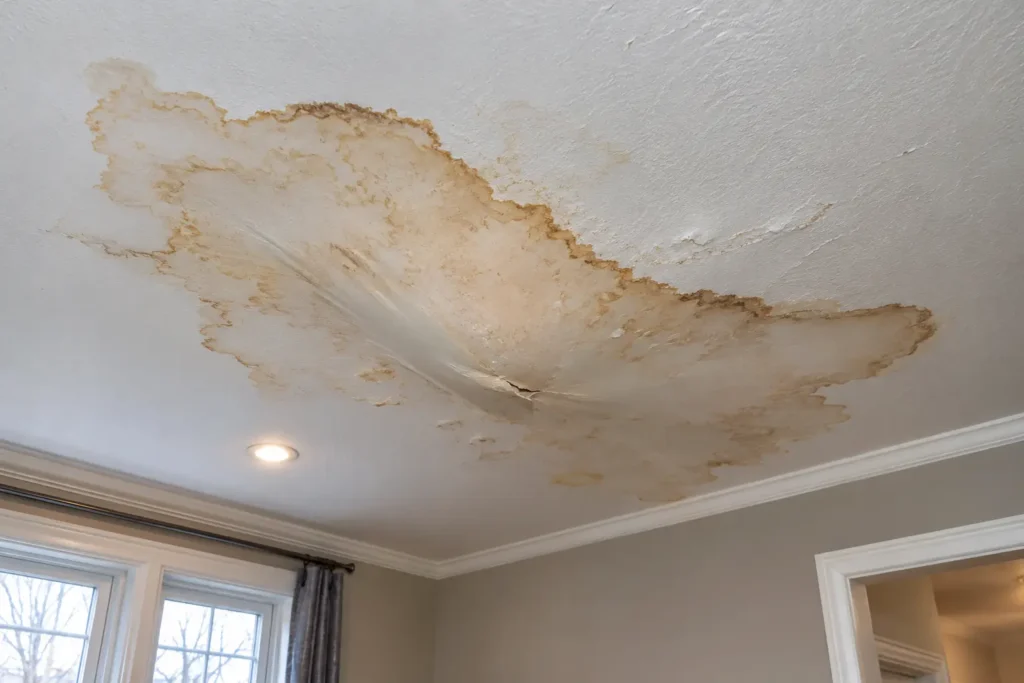
Roof leak water damage Peoria IL homeowners discover is almost never limited to what they can see from inside the house. The ceiling stain that finally prompted the call – the brown ring spreading across the drywall, the paint bubble that appeared after last week’s rain – is the end of a water travel path that started at the roof surface and worked its way through the attic assembly, insulation, and ceiling framing before becoming visible at all.
By the time a roof leak shows up on a ceiling, the interior structure above it has been wet for some time. Understanding where water goes after it enters through a damaged roof is what makes the difference between addressing the actual damage and addressing only what’s visible.
Why Peoria Homes Face Elevated Roof Leak Risk in Fall and Winter
Peoria’s weather pattern creates specific roof leak risk windows that repeat every year. Fall brings the combination of leaf debris accumulating in gutters and valleys, early freeze events that create ice formation in compromised roofing materials, and the heavy rainfall systems that move through central Illinois in October and November.
Winter adds the freeze-thaw dynamic that causes more roof failures in Peoria than any other season. Older roofing materials – 3-tab asphalt shingles that are 15 to 20 years old, cracked flashing around chimneys and vents, degraded sealant at penetration points – absorb water during rain events. When that water freezes and expands overnight, it widens existing cracks and gaps. The next rain event enters through openings that weren’t there six months ago.
In established Peoria neighborhoods like Hanna City, Bartonville, and West Central, where a significant portion of the housing stock was built in the 1950s through 1970s, original roofing materials have long since been replaced – but the flashing, penetration seals, and underlayment beneath the visible shingles may not have been addressed with the same consistency. These are the failure points that most commonly produce roof leak water damage in Peoria homes.
The Path Water Takes From the Roof to Your Ceiling
Roof leak water damage Peoria IL situations are consistently more extensive than the visible ceiling damage suggests because of how water travels once it enters the roof assembly.
Water that enters through a damaged shingle, failed flashing, or compromised ridge cap doesn’t fall straight down. It follows the path of least resistance – along the slope of the roof sheathing, across the top of ceiling insulation, and downward through any available gap in the vapor barrier or ceiling assembly. Where it exits at the ceiling surface depends on where it finds that gap, which is often not directly below where the leak entered the roof.
Step 1 – Roof surface penetration: Water enters through damaged shingles, failed flashing around a chimney or vent pipe, a compromised ridge cap, or a cracked sealant point at a penetration.
Step 2 – Roof sheathing saturation: Water contacts the plywood or OSB roof sheathing beneath the shingles. Sheathing absorbs moisture immediately and begins deteriorating at the entry point. In a roof that has been leaking for multiple rain events, the sheathing damage extends significantly beyond the visible entry point.
Step 3 – Attic assembly contact: Water drips from the sheathing onto rafters or trusses, runs down framing members, and contacts attic insulation. Insulation absorbs water readily and holds it against adjacent framing, creating sustained moisture contact with structural wood that drives rot and mold growth.
Step 4 – Ceiling assembly saturation: Water that migrates through insulation contacts the ceiling drywall or plaster above the living space. It pools at low points in the ceiling assembly – typically at a joist or blocking member – until it saturates through to the visible surface.
Step 5 – Visible ceiling stain: The stain that the homeowner sees is the final step in this sequence, representing water that has already traveled through multiple structural components above.
What a Roof Leak Does to Your Attic
The attic is where most of the structural damage from a roof leak accumulates before anyone knows the leak exists. Our attic damage restoration service regularly uncovers damage in Peoria attics that has been developing for multiple rain seasons without any visible ceiling indication in the living space below.
Roof sheathing deterioration – OSB and plywood sheathing loses structural integrity when wet. OSB in particular swells, delaminates, and deteriorates rapidly with repeated wet-dry cycles from seasonal leaking. Sheathing that has been wet through multiple seasons may appear intact from below while having lost significant load-bearing capacity.
Rafter and truss damage – wood rafters and truss members in sustained contact with moisture develop surface mold within 24 to 48 hours and begin structurally degrading over longer periods. A rafter that has been contacted by roof leak water through multiple seasons may show visible dark staining and surface mold while early-stage structural deterioration has begun.
Insulation saturation – fiberglass batt insulation saturated by a roof leak loses its R-value and holds moisture against adjacent framing members. Wet insulation doesn’t recover its thermal performance when dried – it requires replacement. Our wet insulation removal and replacement service assesses attic insulation condition and moisture content before any restoration plan is developed.
Mold establishment – the combination of wet wood, wet insulation, and limited attic airflow creates near-ideal mold growth conditions. Attic mold in Peoria homes is a consistent finding after roof leaks that went unaddressed for more than a few weeks.
Ceiling Water Damage – What’s Actually Happening Above the Stain
The ceiling stain is the visible signal – but what matters structurally is what’s happening above it. Our ceiling water damage restoration service starts with assessment of the full ceiling assembly, not just the stained area, because the structural moisture extent is almost always larger than the visible discoloration.
Drywall saturation – ceiling drywall that has been contacted by a roof leak absorbs moisture into the gypsum core. Drywall that feels dry to the touch may still have elevated moisture readings. Drywall that has been repeatedly wetted and dried may show acceptable surface readings while harboring mold growth inside the paper backing.
Ceiling joist contact – water pooling above a ceiling stain is in direct contact with the ceiling joists above. Joists that have been contacted by standing water above the ceiling show elevated moisture readings that extend beyond the visible stain area.
Sagging ceiling risk – a ceiling that has absorbed significant water weight can sag and fail structurally. Drywall that feels soft or sounds hollow when tapped in the area of a water stain should not be pressured from below – it may release. This is a situation where professional assessment before any intrusive cleanup work begins is genuinely important.
Roof Leak Water Damage and Mold – The Timeline That Matters
Roof leak water damage Peoria IL situations carry a specific mold risk that differs from flooding events – the moisture accumulation is gradual and ongoing rather than a single event. Each rain event adds more moisture to already-wet attic materials before the previous moisture has fully dried.
This cumulative wet-dry cycling is worse for mold development than a single large water event in many cases. Single flooding events create a clear start point and can be addressed with professional extraction and drying. A roof leak that has been occurring through multiple rain events has created sustained moisture conditions in the attic assembly – exactly the conditions that allow mold to establish and spread before anyone detects the problem.
In Peoria’s fall and winter months, when outdoor temperatures keep attics cold and attic airflow is reduced, wet attic materials dry even more slowly between rain events. A roof that leaked in September, October, and November may have attic insulation and framing with mold colonies that are well-established before the ceiling stain appears in December.
Emergency Tarping vs Permanent Roof Repair – What Comes First
When a roof leak is discovered during or immediately after a rain event, the immediate priority is stopping additional water from entering – not the interior restoration work. Emergency tarping over the damaged section prevents additional water entry while a permanent repair is scheduled.
Our roof leak repair and water damage mitigation service starts with emergency stabilization – temporary coverage of the active leak point – before the interior assessment begins. Interior restoration work in an area that still has an active leak overhead is restoration that gets undone by the next rain event.
The sequence matters: stop the water source, then assess and address the interior damage. Starting with drywall replacement or ceiling restoration before the roof is repaired is the most consistent way to repeat the interior damage within one weather cycle.
What Professional Roof Leak Water Damage Cleanup Involves
Once the roof has been stabilized and water entry is stopped, interior restoration follows a structured process:
Moisture mapping – thermal imaging and calibrated moisture meters map every wet zone in the attic assembly and ceiling structure, identifying the full extent of moisture beyond the visible stain.
Material assessment – attic insulation, roof sheathing, rafters, and ceiling drywall are each assessed for moisture content and structural condition. The assessment determines what can be dried in place versus what requires removal.
Extraction and structural drying – commercial drying equipment addresses the attic and ceiling assembly simultaneously. Attic drying requires equipment positioned to create airflow through the specific wet zones identified in the moisture map. For a full breakdown of the structural drying process and what it involves in Peoria’s climate conditions, our structural drying guide covers the process and timeline in detail.
Material removal – saturated insulation, deteriorated sheathing sections, and water-damaged drywall are removed after the moisture source is confirmed stopped and before reconstruction begins.
Reconstruction – new insulation, drywall, and finish work restore the attic and ceiling after drying is confirmed complete.
Older Peoria Homes and Roof Leak Risk – What Makes the Interior Damage More Complex
In Hanna City and comparable older Peoria County communities, roof leak water damage restoration involves specific complexity from the construction materials in place.
Pre-1970s homes in these areas often have real plaster ceilings rather than drywall. Plaster absorbs water differently from drywall – it’s more resistant to immediate failure but holds moisture for longer and develops different damage patterns. Plaster that has been wetted by a roof leak may feel solid while harboring significant moisture inside the lath structure behind it.
Older attic insulation materials – vermiculite, horsehair plaster, or early fiberglass batts that have compacted with age – behave differently under moisture exposure than modern insulation. These materials also have specific handling requirements if the home was built during eras when certain materials were standard in construction.
Any attic work in a pre-1978 Peoria home should include an assessment for asbestos-containing materials before insulation removal or disturbing any attic components – Illinois regulations require proper testing and handling protocols for these materials.
Final Thought – Roof Leak Water Damage Peoria IL Is Always Bigger Than the Stain
Roof leak water damage Peoria IL situations almost always involve more structural damage than the ceiling stain indicates. The stain is the end of a water travel path that started at the roof surface and moved through multiple structural components before becoming visible. Addressing only the stain while leaving the attic moisture, insulation, and structural damage unaddressed creates the conditions for mold, structural deterioration, and repeated interior damage with every subsequent rain.
For roof leak water damage Peoria IL response right now, call (309) 549-1827 – available 24 hours a day, seven days a week, with same-day assessment and emergency tarping across Peoria and surrounding Peoria County communities.
FAQ Section
Q1: How do I know if a ceiling stain is from an active roof leak or an old one?
A stain that changes size or darkness after rain events is from an active leak. A stain that has remained consistent in size and color for months without growing is likely from a past event that was resolved. The only way to confirm whether active moisture is present above the ceiling is a moisture meter reading in the stained area and in the attic above it. A dry reading after a rain event suggests the leak may have been addressed; an elevated reading confirms active moisture intrusion is ongoing.
Q2: Can I paint over a ceiling water stain after fixing the roof?
Only after confirming the ceiling drywall has returned to safe moisture levels and that mold isn’t present in the ceiling assembly. Painting over a wet stain traps moisture and accelerates mold growth behind the painted surface. Painting over a dry stain without stain-blocking primer will result in the stain bleeding through the paint within weeks. The correct sequence is: confirm dry readings, assess for mold, apply stain-blocking primer, then finish paint.
Q3: How long can a roof leak go undetected in a Peoria home?
A roof leak through a small penetration point or failed flashing can go undetected for multiple rain seasons – sometimes years – before appearing at a ceiling surface. Leaks that enter in one location and travel laterally before exiting may never appear directly below the entry point. Annual attic inspections after Peoria’s storm seasons, looking for water staining on rafters and sheathing, are the most reliable way to catch roof leaks before they develop significant interior damage.
Q4: Does homeowner’s insurance cover roof leak water damage in Illinois?
Standard Illinois homeowner’s insurance covers sudden and accidental roof leak damage – a storm event that damages shingles and allows water in. Gradual damage from a roof that was known to be in poor condition may face coverage limitations. Damage from deferred maintenance – a roof that needed replacement but wasn’t addressed – is typically excluded. Documenting the condition of the roof before and after any storm event, and reporting claims promptly, are the practical steps for claim processing.
Q5: What’s the difference between a roof leak and an ice dam in a Peoria winter?
A roof leak is water entering through a compromised roof component – damaged shingles, failed flashing, a cracked penetration seal. An ice dam is a ridge of ice that forms at the roof edge during freeze-thaw cycles, blocking meltwater from draining and forcing it back under the shingles. Both produce interior water damage and ceiling staining, but they require different roof-level solutions. Ice dam damage is common in Peoria winters when daytime temperatures rise above freezing while rooflines remain cold.
Q6: How much of my attic is typically affected when I discover a ceiling stain?
The affected attic area is almost always larger than the ceiling stain below it. Water that enters at a roof penetration point contacts sheathing that it follows to a low point before dripping to the insulation below – which means the wettest point in the attic may be offset from the ceiling stain location. Moisture mapping typically reveals wet zones in the attic that extend two to four feet beyond the visible ceiling damage boundary.
[…] By the time a stain appears, the attic and wall materials above it have been wet for a while. Our roof leak water damage guide walks through the same water travel path for ordinary roof […]
[…] Water travels along rafters, soaks attic insulation, and shows up later as ceiling stains. Our roof leak water damage guide explains how far that water can travel before you see it. The roofing repair and the interior […]