
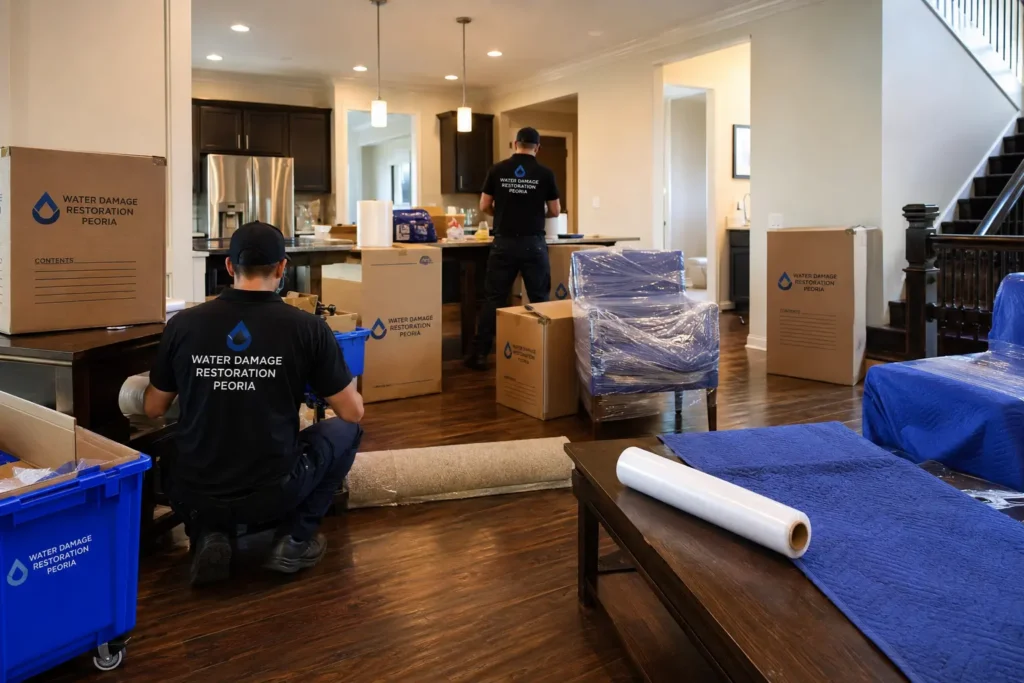
Contents restoration Peoria IL homeowners need after a flooding or fire event is one of the most emotionally charged parts of any disaster recovery. The structural damage – wet walls, damaged flooring, compromised framing – is stressful. But the belongings inside the structure are often what homeowners are most worried about: family photos, electronics, furniture that’s been in the family for decades, business documents that can’t be replaced.
The honest answer to what can be saved is: more than most people assume, if the response starts fast enough and the right process is followed. This guide covers what contents restoration actually involves, what determines whether an item is salvageable, and why the pack-out process matters more than most homeowners realize.
What Contents Restoration Actually Means
Contents restoration Peoria IL refers to the professional cleaning, drying, deodorizing, and restoration of personal property damaged by water, fire, smoke, or mold inside a home – furniture, clothing, electronics, documents, artwork, and other belongings – that have been damaged by water, fire, smoke, or mold.
It is a separate service from structural restoration. Structural restoration addresses the building – walls, floors, framing, insulation. Contents restoration addresses everything inside the building that was affected by the same event.
The two often run in parallel. While structural drying equipment runs inside the home, contents that have been removed to a controlled environment can be assessed, dried, cleaned, and treated simultaneously. This parallel approach is what shortens the total recovery timeline and maximizes the number of items that can be successfully restored.
Contents restoration Peoria IL jobs most commonly follow water damage flooding events during Illinois River surge season, fire and smoke events, and sewage backup situations where category 3 contamination has affected personal property alongside structural materials.
The Pack-Out Process – Why Belongings Get Removed Before Restoration
The first step in contents restoration is almost always a pack-out – the systematic removal of belongings from the damaged space before structural work begins.
Pack-out matters for several reasons. Belongings left in a space while structural drying equipment runs are exposed to the heat and air movement that drying requires, which can accelerate damage to some materials. In fire and smoke damage situations, belongings left in place continue absorbing odor compounds that penetrate deeper into materials the longer exposure continues. In mold remediation situations, cross-contamination risk during material removal makes it essential to get contents out before demolition work begins.
Our content pack-out services process starts with a complete inventory of every item removed – photographed, catalogued, and documented before anything leaves the property. This documentation serves two purposes: it establishes a chain of custody for everything that’s been removed, and it provides the inventory that insurance adjusters need to process contents claims accurately.
Items are sorted during pack-out into three categories – restorable, potentially restorable pending assessment, and total loss. Total loss determination happens at the facility after cleaning is attempted, not during pack-out, because many items that look like total losses are successfully restored once proper cleaning methods are applied. This is why contents restoration Peoria IL jobs almost always begin with pack-out before any structural work starts – the two processes need to run in parallel, not sequentially.
What Can Be Saved And What Determines It
In every contents restoration Peoria IL job, two factors determine whether a damaged item can be restored – the type of damage it sustained and how long it was exposed before the pack-out started.
Items with the highest restoration success rate:
- Solid wood furniture – wood that was wet but not submerged for extended periods can be dried, sanded, and refinished successfully in most cases. Veneer furniture and particleboard have much lower success rates because they swell and delaminate on water contact.
- Hard-surface items – ceramics, glass, metal, and plastics generally clean well and are restorable from water and smoke damage unless there is physical breakage.
- Clothing and textiles – professional ultrasonic cleaning and ozone treatment restore most clothing and fabric items from smoke and water damage that household washing cannot address.
- Documents and photos – caught early, documents and photographs have higher restoration rates than most people expect. Our document drying and restoration service uses freeze-drying techniques for severely wet documents that prevent further deterioration while restoration is underway.
- Artwork – paintings, prints, and framed pieces require specialized assessment, but many are restorable with proper conservation techniques when addressed promptly.
Items with lower restoration success rates:
- Upholstered furniture that sustained category 3 water contact – the contamination penetrates foam and batting in ways that can’t be fully decontaminated
- Particleboard and MDF furniture that swelled on water contact – dimensional change is irreversible
- Electronics submerged in water for extended periods – though many electronics exposed to water damage but recovered quickly are successfully restored
- Electronics Restoration After Water or Fire Damage
- Electronics are one of the categories homeowners most frequently write off as total losses when they are actually often restorable. The key variable is time – an electronic device that was wet for two hours has a fundamentally different restoration prognosis than one that sat wet for 48 hours.
- Water damage to electronics causes corrosion at the circuit board level when mineral deposits from the water are left to dry on conductive surfaces. Professional restoration removes those deposits before they can cause permanent damage using ultrasonic cleaning – a process that uses high-frequency sound waves in a cleaning solution to remove contamination from circuit boards and components without physical contact.
- Our electronics restoration service assesses each device individually before any cleaning attempt. Devices that have been submerged in category 3 water – sewage, floodwater – carry contamination risks that affect the assessment differently than clean water intrusion. Smoke damage to electronics leaves residue on heat sinks and cooling fans that can cause overheating failures months after the original event if not professionally cleaned.
- The most important thing Peoria homeowners can do with electronics after water damage is not attempt to power them on. Powering on a wet or damp electronic device causes the corrosion process to accelerate and often creates a short circuit that permanently destroys components that would otherwise be restorable.
Document and Photo Restoration – What’s Actually Possible
Documents and photographs are among the most irreplaceable items in any home – and also among the most successfully restored when the right process is applied quickly.
Wet paper begins to deteriorate within hours. Documents that have been wet for more than 24 to 48 hours develop mold on the surface and the paper fibers begin to break down. But documents recovered within the first 24 hours, even those that appear heavily damaged, have high restoration rates using professional freeze-drying.
Freeze-drying removes moisture from wet documents without the documents passing through a liquid state – the water goes directly from solid (frozen) to vapor, which prevents the paper distortion and ink bleeding that normal drying causes. This process is used by archivists and libraries for document recovery and produces results that conventional drying cannot approach.
Photographs follow similar principles but have additional considerations based on print type. Inkjet prints are more vulnerable to water damage than traditional chemical prints, but both benefit from prompt professional intervention rather than household drying attempts.
According to the National Archives guidance on water damage to historical documents, prompt freezing of wet documents – even in a household freezer – stabilizes them and prevents further deterioration until professional treatment can begin. This is practical advice for Peoria homeowners: if documents get wet during a flooding event and professional help isn’t immediately available, freezing them is a better immediate action than attempting to air dry them.
Contents Restoration After Fire and Smoke Damage
Contents restoration Peoria IL jobs that follow a fire event have different priorities than water damage jobs. The primary contaminant isn’t water – it’s soot and smoke residue – and the restoration challenge is deodorization as much as physical cleaning.
Smoke penetrates deeply into porous materials. Clothing, upholstered furniture, window treatments, and bedding absorb smoke compounds at a molecular level that standard washing doesn’t address. Professional restoration uses ozone treatment and hydroxyl generation to break down odor compounds inside the materials rather than masking them on the surface.
For Peoria homeowners dealing with the aftermath of a fire, our smoke damage restoration guide covers the full structural side of fire recovery – and the contents restoration process runs parallel to that structural work, not after it.
Soot on hard surfaces – furniture, shelving, appliances – is acidic and begins etching surfaces within hours of deposition. Items that look like candidates for total loss because they’re heavily soot-coated are often fully restorable if cleaning begins within the first 24 to 48 hours.
Insurance and Contents Restoration – What You Need to Know
Contents claims are a significant portion of most water and fire damage insurance claims, and they’re also the portion most frequently under-documented by homeowners.
Insurance adjusters process contents claims based on an inventory of damaged items with replacement value documentation. Homeowners who attempt to document this themselves – from memory, after the fact – consistently recover less than homeowners whose restoration company created a professional inventory during pack-out.
The professional inventory created during our pack-out process includes photographs of each item, a description of the damage, and a record of what restoration was attempted and the result. This documentation is what adjusters need to process a complete contents claim. Attempting to reconstruct this information after items have been moved or discarded makes the claim process significantly harder.
For a full understanding of what gets repaired versus replaced during the structural side of a water damage claim, our water damage repair guide covers how restoration decisions get made for the building itself – and the same principles of documentation and assessment apply to contents.
Contents Restoration in East Peoria and Surrounding Communities
Our contents restoration team serves Peoria and surrounding communities including East Peoria, West Central, Bartonville, Dunlap, North Florence, and Peoria Heights. For East Peoria homeowners specifically, where the Illinois River flooding risk extends across the river from Peoria proper, contents restoration following basement flooding events is one of the most common service calls we handle – particularly for finished basement spaces where furniture, electronics, and stored personal belongings are the primary loss category.
Final Thought – Contents Restoration Peoria IL Starts the Same Day
Contents restoration Peoria IL response needs to start as quickly as the structural response. Every hour belongings sit in a damaged environment – absorbing more smoke, continuing to corrode, developing mold on wet surfaces – reduces the number of items that can be successfully restored.
The decision about what can be saved is not made by looking at items in place. It’s made by a professional assessment at a controlled facility, after pack-out, after initial cleaning attempts. Writing off belongings before that assessment has happened means leaving restorable items – sometimes items with significant monetary or sentimental value – behind unnecessarily.
For contents restoration Peoria IL response right now, call (309) 549-1827 – available 24 hours a day, seven days a week, with same-day pack-out assessment across Peoria and surrounding Peoria County communities.
Leave a Reply