
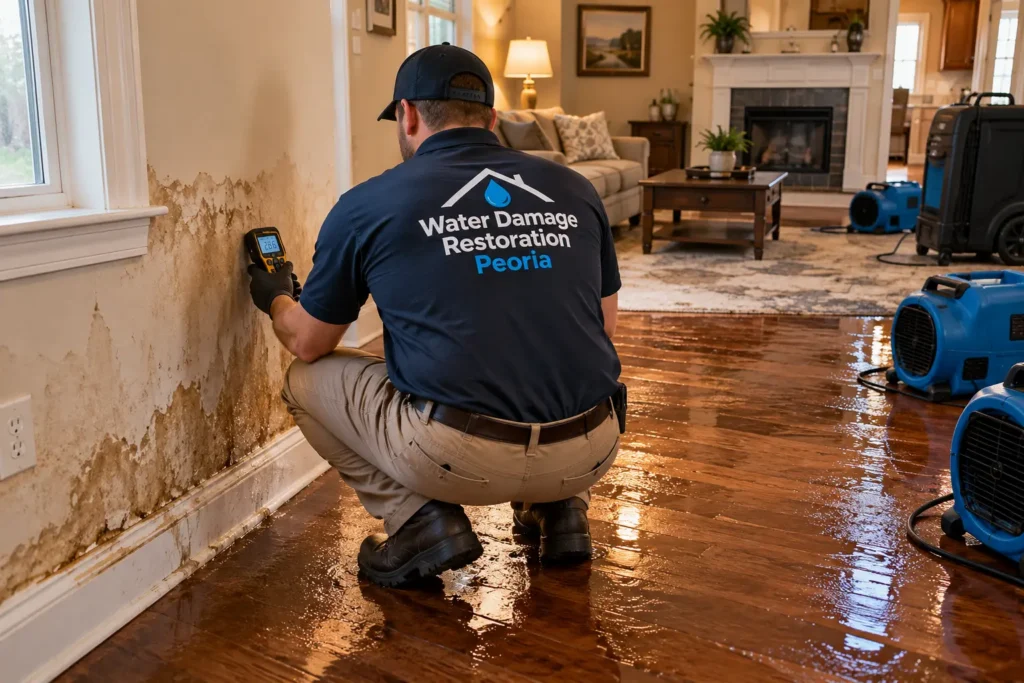
Residential water damage restoration Peoria IL homeowners need after a flooding event is a specific service with its own process, timeline, and considerations – and it’s worth understanding what makes it different from commercial restoration before you start calling companies.
Most of what gets written about water damage restoration online treats all jobs as equivalent. They’re not. A flooded office building and a flooded Peoria home require the same core technical work – extraction, drying, assessment, reconstruction – but they operate under completely different priorities, timelines, and emotional stakes.
What Residential Water Damage Restoration Actually Involves
Residential water damage restoration Peoria IL jobs address water intrusion in single-family homes, townhomes, and condominiums across Peoria and surrounding Peoria County communities. The service covers the full scope of what happens after water enters a home – from emergency extraction through structural drying and reconstruction.
The core phases of any residential restoration job:
- Emergency extraction – removing standing water using commercial-grade equipment before it spreads further into structural materials
- Moisture mapping – identifying every wet zone using thermal imaging and calibrated moisture meters, including areas that show no visible surface damage
- Structural drying – running commercial dehumidifiers and air movers until all structural materials return to acceptable moisture levels, confirmed by daily readings
- Material assessment – determining what can be dried in place versus what requires removal and replacement
- Antimicrobial treatment – applied to all affected surfaces to prevent mold establishment during and after the drying phase
- Reconstruction – replacing removed drywall, flooring, insulation, and other materials after drying is confirmed complete
For a detailed breakdown of how the drying phase works in Peoria’s specific climate conditions, our structural drying guide covers why Peoria jobs take longer than national averages and what daily monitoring involves.
How Residential Restoration Differs From Commercial – What Homeowners Should Know
The technical process is similar. The context around it is completely different.
The home is occupied – in most residential water damage jobs, the family is either still in the home during restoration or has been displaced to temporary housing. This creates a human dynamic that commercial jobs don’t have. Decisions about what to save and what to replace carry emotional weight alongside practical weight. Communication needs to happen with the homeowner directly, not through a facilities manager or property management company.
The scope is personal – a commercial water damage job affects a business’s ability to generate revenue. A residential job affects where a family sleeps, where children do homework, whether the kitchen is usable. These stakes are different, and the restoration approach needs to account for the personal nature of the affected space.
Insurance works differently – standard Illinois homeowner’s insurance handles water damage claims differently from commercial property insurance. The adjuster process, documentation requirements, and coverage exclusions differ. What a residential policy covers from a burst pipe differs from what it covers for groundwater intrusion or Illinois River flooding – and knowing those distinctions matters before the claim is filed.
The timeline pressure is different – commercial restoration operates under revenue loss pressure. Residential restoration operates under displacement pressure. A family temporarily out of their home has different urgency than a business that can’t open – and that affects how reconstruction timelines get prioritized and communicated. This is what makes residential water damage restoration Peoria IL a fundamentally more personal engagement than commercial work – the technical process is the same, but everything around it involves someone’s home and family.
The Most Common Residential Water Damage Sources in Peoria IL
Residential water damage restoration Peoria IL calls follow predictable patterns based on the season and the age of the housing stock.
Illinois River flooding season (March – June) – groundwater intrusion into basements across established Peoria neighborhoods like West Central, East Bluff, and Bartonville is the highest-volume residential water damage scenario during spring. The Illinois River’s seasonal rise pushes the regional water table up across a wide area, and block-foundation homes from the 1940s through 1970s absorb that groundwater readily. This seasonal pattern is what makes residential water damage restoration Peoria IL response speed so critical during March through June – every hour of delay during peak flooding season adds to the total damage scope.
Winter pipe failures (December – March) – burst pipes from freeze events are a consistent residential water damage source during Peoria winters. Supply lines in unheated spaces – garage walls, exterior walls with inadequate insulation, crawl spaces – are the most common failure points. A burst pipe in a wall cavity can release significant water volume before it’s discovered.
Appliance failures – washing machine supply lines, dishwasher connections, water heater failures, and refrigerator water line leaks are year-round sources that account for a large portion of residential water damage calls. These events are typically contained to one area when caught quickly, and escalate significantly when the failure goes unnoticed for hours.
Storm and roof intrusion – severe thunderstorm events common during Peoria’s spring and summer seasons drive water through compromised roof sections, window seals, and damaged siding. This category often involves simultaneous basement flooding from groundwater alongside upper-level water intrusion from the roof.
What Makes Peoria Residential Restoration Specifically More Complex
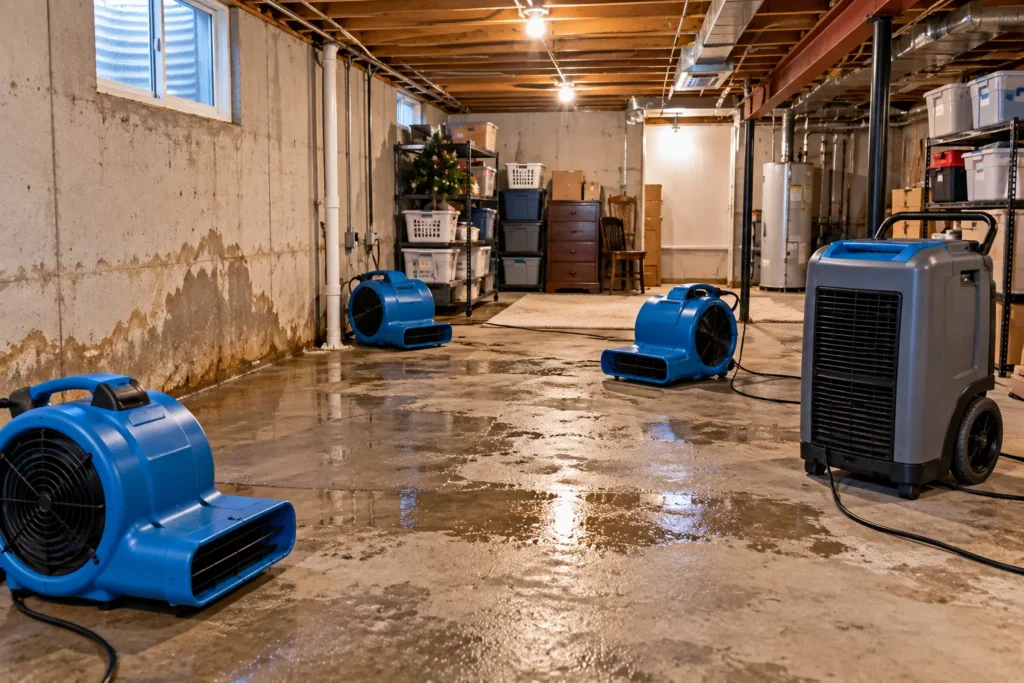
Peoria’s housing stock creates specific challenges in residential water damage restoration that national averages don’t capture.
Older homes in neighborhoods like West Central, Downtown Peoria, and North Florence were built with construction materials and methods that absorb and hold moisture differently than modern construction. Dense plaster walls, real wood lath, and older insulation materials require different drying approaches and longer equipment run times than modern drywall and fiberglass insulation.
Block foundation construction, which is standard across most pre-1970s Peoria residential stock, holds moisture in the block cells for significantly longer than poured concrete. Structural drying of a block foundation wall takes more equipment run time and more monitoring days than an equivalent poured-concrete job – which is why our flooded basement cleanup process includes daily moisture monitoring until all block wall readings confirm dry, regardless of surface appearance.
Clay-heavy Peoria County soil maintains moisture pressure against foundation walls for extended periods after a rain event, which means the moisture source affecting basement walls doesn’t stop when the rain stops. Effective residential restoration in these conditions accounts for ongoing soil moisture pressure, not just the original water intrusion event. These local construction factors are exactly why residential water damage restoration Peoria IL timelines in older neighborhoods consistently run longer than what national restoration averages suggest.
Choosing a Residential Water Damage Restoration Company in Peoria IL
The question homeowners most often ask is how to choose the right restoration company for a residential job. A few practical factors that matter specifically in Peoria:
Local knowledge of construction types – a company that knows Peoria’s block-foundation homes, older construction materials, and seasonal flooding patterns handles residential jobs more efficiently than one applying national-average protocols to local conditions.
Daily moisture documentation – any residential restoration company should provide daily moisture readings at all monitored points. This documentation supports your insurance claim and confirms that reconstruction doesn’t begin over wet materials.
Insurance claim support – residential water damage insurance claims in Illinois involve specific documentation requirements. A restoration company that provides moisture logs, pre and post-extraction photography, and a scope-of-work document makes the adjuster process significantly smoother.
Communication with the homeowner directly – residential restoration involves the person whose home it is, not a corporate facilities team. Clear, direct communication about what’s happening, why, and what comes next is the baseline expectation for any residential job.
For a full breakdown of what the water damage mitigation phase involves before reconstruction begins, our water mitigation guide covers the process that determines how quickly your home is ready for repair. This is the documentation standard that any residential water damage restoration Peoria IL company should meet as a baseline – not an optional add-on.
Areas We Serve for Residential Water Damage Restoration in Peoria IL
Our residential restoration team serves homeowners across Peoria and Peoria County including West Central, East Bluff, Bartonville, North Florence, Center Bluff, Dunlap, Edwards, Hanna City, Peoria Heights, and Downtown Peoria. We also serve surrounding communities including East Peoria in Tazewell County.
For homeowners in older established neighborhoods close to the Illinois River – where block foundations and clay-heavy soil make basement water intrusion a near-annual reality – residential restoration experience with local construction conditions makes a practical difference in how efficiently the job gets done and how completely the moisture is addressed.
Final Thought – Residential Water Damage Restoration Peoria IL Starts With One Call
Residential water damage restoration Peoria IL done right is a structured process that starts with assessment, moves through extraction and drying with daily documentation, and ends with confirmed moisture clearance before any reconstruction begins. The goal isn’t just a dry house – it’s a house that stays dry and stays healthy for the people living in it.
If your Peoria home has experienced water damage from any source, call (309) 549-1827 – available 24 hours a day, seven days a week, with same-day residential assessment and extraction across Peoria and surrounding Peoria County communities.
FAQ Section
Q1: What is residential water damage restoration?
Residential water damage restoration is the professional process of extracting water, drying structural materials, assessing and removing damaged materials, and reconstructing affected areas in a home after a water intrusion event. It covers everything from the initial emergency response through final reconstruction and confirmation that all materials have returned to safe moisture levels. Residential water damage restoration Peoria IL jobs follow this same sequence regardless of whether the water source was a burst pipe, a flooded basement, or storm intrusion through the roof.
Q2: How long does residential water damage restoration take in Peoria IL?
Timeline depends on the scope of the water event, the materials affected, and how quickly extraction began. Most moderate residential water damage jobs in Peoria complete in two to four weeks from extraction through final reconstruction. Jobs involving older construction, block foundations, or delayed extraction typically run longer because of extended structural drying requirements.
Q3: Does homeowner’s insurance cover residential water damage restoration in Illinois?
Standard Illinois homeowner’s insurance covers sudden and accidental water damage from internal sources – burst pipes, appliance failures, and storm intrusion through the building envelope. It typically doesn’t cover groundwater intrusion from outside the home or Illinois River flooding, which requires separate flood insurance through FEMA’s National Flood Insurance Program. Contacting your insurer the same day as the water event and documenting conditions before cleanup begins are the two most important steps for claim processing.
Q4: How is residential water damage different from commercial water damage restoration?
The core technical process – extraction, drying, disinfection, reconstruction – is the same. Residential jobs involve occupied or recently displaced family homes, personal property with sentimental value, and homeowner insurance claims. Commercial jobs involve business continuity pressure, regulatory compliance for reopening, and commercial property insurance with different coverage terms. The communication, timeline priorities, and emotional context are fundamentally different.
Q5: How do I know if my home has hidden water damage?
Common indicators of hidden water damage include musty odors in specific rooms, soft spots in flooring, water stains that reappear after painting, unexplained increases in water bills, and efflorescence on basement walls. Professional moisture mapping using thermal imaging and calibrated moisture meters identifies hidden moisture that visual inspection misses. Our hidden leak detection guide covers the warning signs in detail.
Q6: What should I do immediately after water damage in my Peoria home?
Confirm electrical safety before entering any flooded area. Document all damage with photographs and video before moving anything or starting cleanup. Contact your insurance company the same day. Call a professional restoration company immediately – every hour between the water event and professional extraction increases the scope of material saturation and mold risk. Do not run HVAC systems, which spread moisture and contamination through ductwork.
Leave a Reply